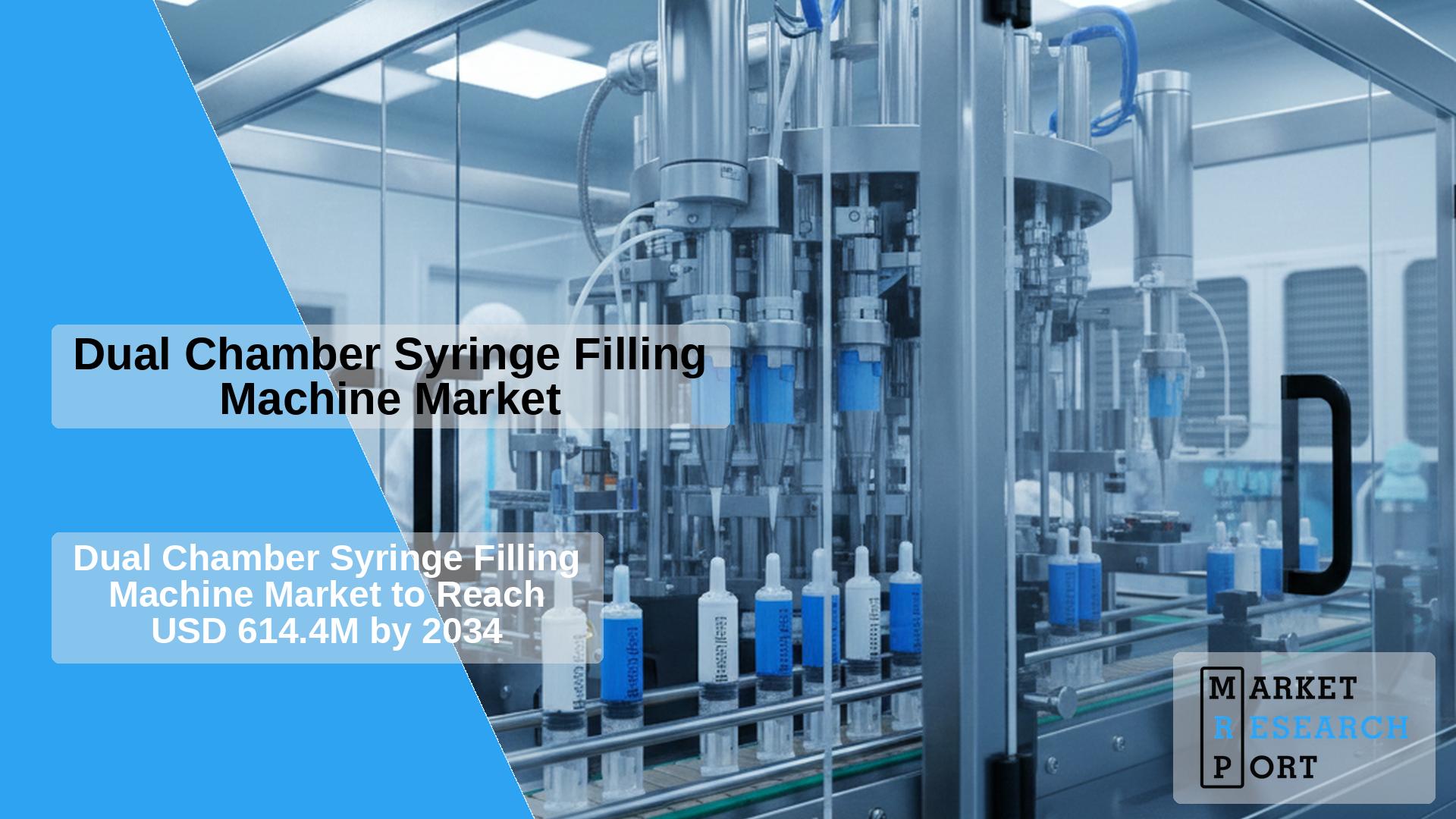
The global Dual Chamber Syringe Filling Machine Market is projected to grow from USD 276.8 Million in 2024 to USD 614.4 Million by 2034, at a CAGR of 8.3%. These machines are essential in pharmaceutical production, offering precise and sterile filling for multi-component medications.
Dual chamber systems allow for separate storage of active ingredients and diluents, reducing preparation time and minimizing dosing errors. Their adoption is increasing as pharmaceutical manufacturers prioritize efficiency, safety, and compliance with strict global regulatory standards. These machines serve critical applications in biologics, vaccines, and emergency medications, where rapid and accurate reconstitution is vital.
High-capacity models can process between 1,000 to 3,000 syringes per hour, while advanced automatic machines reach speeds of up to 400 syringes per minute. Semi-automatic machines serve mid-sized production needs, and manual systems continue to support specialized small-batch or research operations. These capabilities make dual chamber syringe filling machines highly valuable for both commercial and clinical production.
Automatic machines dominate the market thanks to their speed, precision, and ability to minimize human error. They integrate with production lines and offer real-time monitoring for consistent quality control. Semi-automatic machines balance cost with functionality, serving mid-sized manufacturers seeking upgraded capabilities without heavy investment. Manual machines remain relevant for small-scale operations or research facilities, offering precise control in specialized production scenarios.
Industrial pharmacy is the largest application segment, driven by the need for large-scale, high-volume production of injectable medications. These facilities require automated solutions that comply with regulatory standards while ensuring sterility and precision. Hospital pharmacy applications, although smaller, are growing due to demand for patient-specific dosages and immediate availability of combination therapies, requiring compact, flexible filling systems.
The rise in chronic diseases such as diabetes, cardiovascular disorders, and autoimmune conditions is fueling demand for dual-chamber syringes. These devices allow for accurate mixing of multi-component drugs, reducing preparation errors. Pharmaceutical companies are increasingly investing in smart, automated production systems that feature IoT connectivity, predictive maintenance, and real-time monitoring. This enhances operational efficiency and ensures consistent product quality.
Strict global regulations impose significant challenges. Compliance with FDA, EMA, and other authorities requires rigorous testing, documentation, and validation processes. Maintaining sterility and preventing cross-contamination between chambers adds complexity, increasing costs and limiting rapid adoption. The need for specialized technical skills further restricts deployment in some regions.
The growing demand for combination therapies and personalized medicine is expanding opportunities for dual chamber filling machines. Contract manufacturing organizations (CDMOs) are investing in these systems to offer specialized services to pharmaceutical clients lacking in-house capabilities. Integration of IoT and automation provides data-driven insights, predictive maintenance, and operational efficiency, creating additional value for manufacturers.
There is a shift toward modular and flexible production systems that can quickly adapt to multiple product formats. Small-batch production and personalized medicine are driving innovations in quick-changeover systems and automated cleaning processes. Strategic partnerships between equipment manufacturers and pharmaceutical companies are becoming common to co-develop customized filling solutions, accelerating technology adoption.
North America dominates the market with a 49.2% share, valued at USD 136.1 Million. Strong pharmaceutical and biotechnology sectors, stringent FDA regulations, and investment in combination therapies drive market growth.
Europe has a significant market presence, with Germany, Switzerland, and France leading. Regulatory standards, high biologics production, and an aging population support adoption of dual chamber systems.
Asia Pacific is experiencing rapid growth, led by China, India, Japan, and South Korea. Cost-effective manufacturing, favorable policies, and increasing prevalence of chronic diseases contribute to rising adoption.
The region shows emerging opportunities with modernization of healthcare infrastructure, especially in UAE, Saudi Arabia, and South Africa. Investments in regulatory frameworks and healthcare systems are expected to gradually boost adoption.
Latin America, led by Brazil and Mexico, is witnessing steady growth as pharmaceutical production expands and chronic disease prevalence rises. Economic volatility and regulatory complexity present challenges to widespread adoption.
The global dual chamber syringe filling machine market is highly competitive, with key companies focusing on advanced automation, precision, and regulatory compliance.