
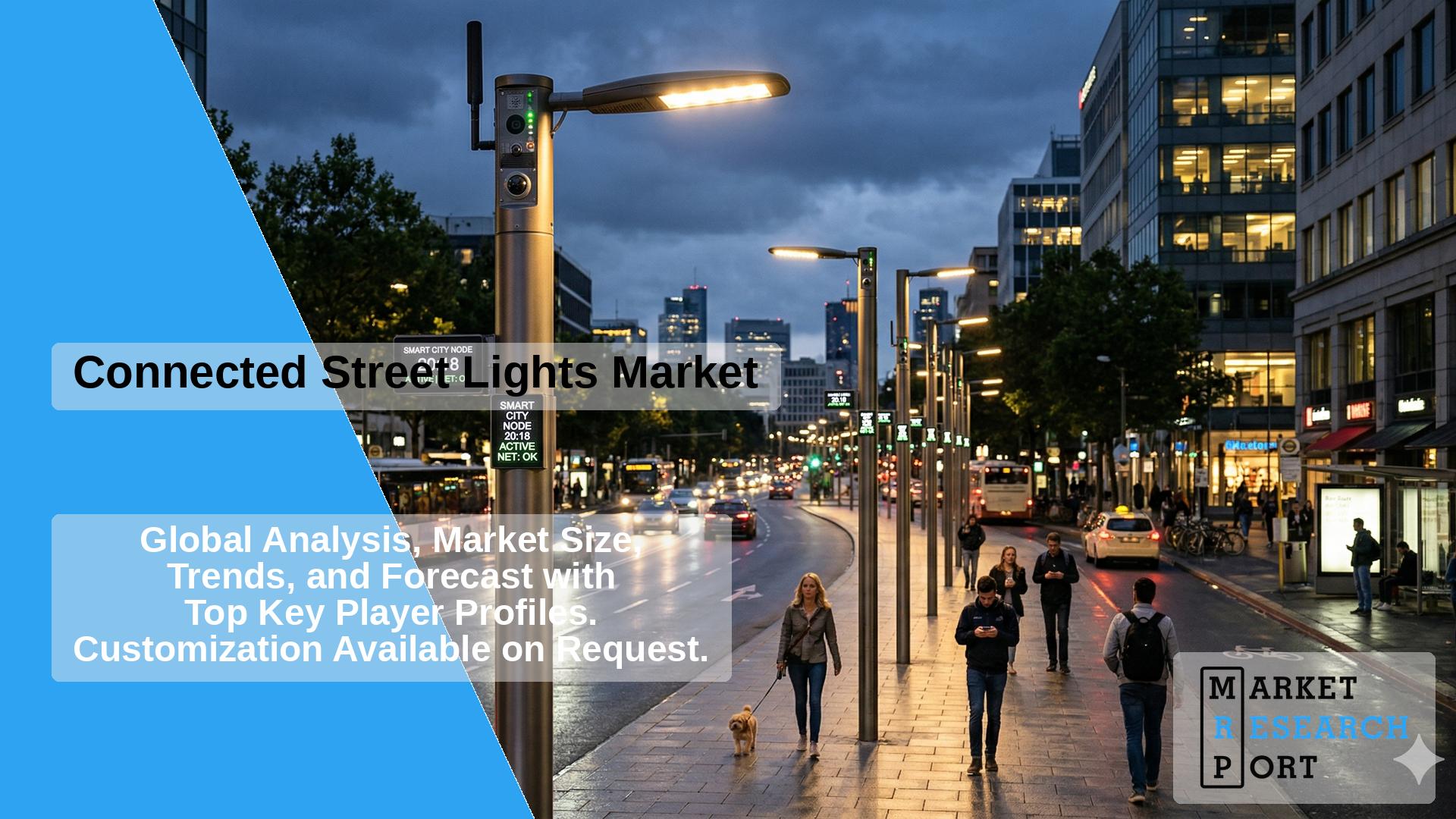
The global connected street lights market size is estimated to be valued at USD 4,850.5 million in 2026 and is projected to reach USD 18,450.2 million by 2036, growing at a CAGR of 14.3% from 2026 to 2036. The market expansion is primarily driven by the rapid acceleration of smart city initiatives worldwide, the urgent need for energy-efficient urban infrastructure, and the integration of advanced Internet of Things (IoT) technologies into public lighting systems. Governments are increasingly prioritizing carbon footprint reduction and operational cost savings, which is facilitating the transition from traditional lighting to intelligent, networked solutions.
The evolution of urban landscapes into interconnected ecosystems has placed connected street lights at the forefront of modern infrastructure. These systems do more than just provide illumination; they serve as a backbone for smart city data collection. By utilizing sensors and communication nodes, connected street lights can adjust brightness based on real-time traffic or pedestrian movement, significantly reducing energy waste. Furthermore, the integration of these systems with central management software allows municipalities to monitor energy consumption, detect faults instantly, and schedule maintenance proactively, thereby reducing long-term operational expenditures. The shift toward LED technology has already provided a baseline for energy savings, but the addition of connectivity layers adds a new dimension of efficiency and functionality.
Despite the optimistic growth trajectory, the market faces hurdles related to high initial capital requirements and concerns over data security. Implementing a city-wide connected lighting network involves substantial upfront costs for hardware, software integration, and labor. Many smaller municipalities struggle to secure the necessary budget without clear evidence of immediate return on investment. Additionally, as street lights become part of a networked grid, they become potential targets for cyberattacks. Ensuring robust encryption and secure communication protocols is essential to prevent unauthorized access to city infrastructure. Interoperability remains another challenge, as the lack of universal standards can lead to vendor lock-in, making it difficult for cities to integrate components from different manufacturers into a single cohesive system.
Opportunities in the market are abundant, particularly with the rollout of 5G technology and the rise of multi-functional smart poles. Connected street lights are increasingly being viewed as ideal mounting points for 5G small cells, environmental sensors, and public Wi-Fi hotspots. The concept of the ‘Smart Pole’ is gaining momentum, where a single light post can serve as an electric vehicle (EV) charging station, a surveillance hub, and an air quality monitoring station. This multi-functionality allows cities to maximize the value of their physical assets. Moreover, the emergence of ‘Lighting-as-a-Service’ (LaaS) business models is helping cities overcome budget constraints by allowing them to pay for lighting performance rather than owning the hardware, shifting the financial burden to service providers and encouraging wider adoption.
The global connected street lights market is characterized by a moderate to high level of concentration, with a few dominant players holding significant market shares. Companies such as Signify, Itron, and Telensa have established strong footprints through extensive R&D and strategic partnerships with municipal governments. These industry leaders focus on providing end-to-end solutions that encompass hardware, connectivity, and cloud-based management platforms. While large-scale players dominate the high-end municipal projects, a growing number of specialized technology firms and regional players are entering the market, offering niche solutions for residential and commercial applications. This competitive environment fosters innovation, particularly in the development of low-power wide-area network (LPWAN) technologies and advanced data analytics tools.
Innovation is a primary driver of market dynamics. Manufacturers are focusing on developing sensors that can distinguish between different types of road users, such as cyclists, pedestrians, and vehicles, to optimize lighting patterns. There is also a significant trend toward the use of edge computing, where data processing occurs at the light pole level rather than in a centralized cloud, reducing latency and bandwidth usage. Environmental sustainability is another key characteristic, with companies developing circular economy initiatives to recycle lighting components and reduce the use of hazardous materials in production. The market is also seeing a shift toward open-source platforms to address interoperability issues, allowing different smart city devices to communicate seamlessly.
The hardware segment accounted for the largest revenue share in 2026. This segment includes LED lamps, communication modules, sensors, and controllers. The high share is attributed to the physical replacement of millions of legacy street lights with intelligent LED units. The integration of sensors, such as Photocell sensors for ambient light detection and Passive Infrared (PIR) sensors for motion detection, is a critical factor driving hardware demand. As cities move toward more sophisticated setups, the demand for advanced controllers that support dimming and real-time monitoring continues to rise. The hardware market is also benefiting from the decreasing cost of electronic components, making smart nodes more affordable for large-scale deployments.
The software and services segments are expected to witness the highest growth rates during the forecast period. Software platforms, often referred to as Central Management Systems (CMS), are the brains of the connected lighting network. They provide a dashboard for city officials to visualize data, manage assets, and automate lighting schedules. The rise of Big Data and AI-driven analytics is transforming these platforms into predictive tools that can forecast energy needs and maintenance requirements. Services, including installation, consulting, and maintenance, are also crucial as municipalities often lack the in-house technical expertise to manage complex IoT networks. The shift toward subscription-based software models ensures a steady stream of recurring revenue for providers.
The wireless connectivity segment is projected to dominate the market throughout the forecast period. Wireless solutions offer unparalleled flexibility and ease of installation compared to wired alternatives. Technologies such as Zigbee, Bluetooth Mesh, and various LPWAN options like LoRaWAN and NB-IoT are widely utilized. NB-IoT, in particular, is seeing rapid adoption due to its ability to support a high density of devices over a wide area with low power consumption, making it ideal for street lighting. Wireless networks eliminate the need for extensive trenching and cabling, which significantly reduces the time and cost associated with deployment. Furthermore, wireless systems are more easily scalable, allowing cities to add or move nodes without major infrastructure changes.
Wired connectivity, primarily through Power Line Communication (PLC), still holds a relevant position in specific markets. PLC uses existing electrical wiring to transmit data, which can be advantageous in areas where wireless signals are obstructed by dense buildings or heavy foliage. It provides a highly stable and secure connection, as the data remains within the physical wires of the utility grid. However, the complexity of managing noise on the power lines and the higher cost of specialized PLC modems have limited its growth compared to wireless technologies. In some hybrid deployments, cities use wired connections for backbone infrastructure while employing wireless nodes for individual light control, balancing stability with flexibility.
Public places, including highways, streets, and bridges, represent the largest application segment. The primary motivation for connected lighting in these areas is public safety and energy efficiency. Well-lit streets are proven to reduce crime rates and traffic accidents. By using connected systems, cities can ensure that lights are always functioning at the required levels while dimming them during low-traffic hours to save energy. High-speed highways are increasingly being equipped with smart lights that can adjust brightness based on weather conditions, such as fog or heavy rain, enhancing driver visibility. The scale of public infrastructure projects ensures that this segment remains the primary driver of market volume.
The commercial and residential segments are also expanding as private developers and homeowners’ associations recognize the benefits of smart lighting. In commercial zones, such as shopping centers and business parks, connected street lights are used to enhance the aesthetic appeal and provide a sense of security for visitors. These systems are often integrated with other building management systems to create a unified smart environment. In residential areas, the focus is on creating ‘smart neighborhoods’ where street lights can be controlled via mobile apps or integrated with home automation systems. The demand for decorative yet functional smart lighting is a key trend in these segments, with a focus on color-changing capabilities and sleek designs.
North America led the global market in 2026, driven by a high concentration of smart city initiatives in the United States and Canada. The region benefits from a mature technological ecosystem and significant investments from both public and private sectors. Federal grants and state-level incentives for energy efficiency have accelerated the replacement of old lighting systems. Major cities like Chicago, Los Angeles, and New York have already implemented large-scale connected lighting projects, serving as blueprints for other municipalities. The presence of leading technology providers and a strong focus on cybersecurity also contribute to the region’s dominant position.
Europe follows closely, with a strong emphasis on sustainability and carbon neutrality. The European Green Deal and various EU directives on energy efficiency have made connected street lights a priority for member states. Countries like Germany, the UK, and France are at the forefront of adopting intelligent lighting to meet their climate goals. The European market is also characterized by a high level of innovation in architectural and decorative smart lighting. The integration of street lights with electric vehicle charging infrastructure is particularly advanced in Northern Europe, where EV adoption rates are among the highest in the world.
Asia Pacific is expected to be the fastest-growing region between 2026 and 2036. Rapid urbanization in China and India is creating a massive demand for new urban infrastructure. The Chinese government’s ‘New Infrastructure’ plan places a heavy emphasis on 5G and IoT, directly benefiting the connected street lights market. In India, the Smart Cities Mission aims to modernize 100 cities, with intelligent lighting being a core component of the plan. The region’s growth is also supported by the presence of major LED manufacturers and a growing middle class that is driving demand for better urban amenities. Southeast Asian countries like Singapore and Vietnam are also investing heavily in smart lighting to improve urban livability.
Latin America and the Middle East & Africa (MEA) are emerging markets with significant potential. In Latin America, cities like Rio de Janeiro and Buenos Aires are implementing large-scale public-private partnerships (PPPs) to modernize their lighting grids. In the MEA region, the Gulf Cooperation Council (GCC) countries, particularly Saudi Arabia and the UAE, are investing in smart city projects as part of their economic diversification strategies. The NEOM project in Saudi Arabia, for instance, is expected to feature some of the most advanced connected lighting systems in the world. While these regions currently hold smaller market shares, their high growth rates make them attractive for global players.
The following are the leading companies in the connected street lights market. These companies are instrumental in driving technological advancements and setting industry standards.
| Report Attribute | Details |
| Market size value in 2026 | USD 4,850.5 million |
| Revenue forecast in 2036 | USD 18,450.2 million |
| Growth rate | CAGR of 14.3% from 2026 to 2036 |
| Base year for estimation | 2025 |
| Historical data | 2020 – 2024 |
| Forecast period | 2026 – 2036 |
| Quantitative units | Revenue in USD million and CAGR from 2026 to 2036 |
| Report coverage | Revenue forecast, company ranking, competitive landscape, growth factors, and trends |
| Segments covered | Component, Connectivity, Application, Region |
| Regional scope | North America; Europe; Asia Pacific; Latin America; Middle East & Africa |
| Country scope | U.S.; Canada; UK; Germany; France; China; India; Japan; Brazil; Saudi Arabia |
| Key companies profiled | Signify; Itron; Telensa; Acuity Brands; Schreder; GE Current; Sensus; Cimcon Lighting; Ubicquia; Flashnet |
This report forecasts revenue growth at global, regional, and country levels and provides an analysis of the latest industry trends in each of the sub-segments from 2026 to 2036.
Component Outlook (Revenue, USD Million, 2026 – 2036)
Connectivity Outlook (Revenue, USD Million, 2026 – 2036)
Application Outlook (Revenue, USD Million, 2026 – 2036)
Region Outlook (Revenue, USD Million, 2026 – 2036)
1. What is the projected market size of the connected street lights market by 2036?
The global market is expected to reach USD 18,450.2 million by 2036, driven by smart city expansions and energy efficiency goals.
2. What is the expected growth rate (CAGR) for the market?
The market is projected to grow at a compound annual growth rate (CAGR) of 14.3% from 2026 to 2036.
3. Which region is currently leading the connected street lights market?
North America is the leading region as of 2026, due to early technological adoption and significant government investment in IoT infrastructure.
4. Which connectivity technology is most preferred in this market?
Wireless connectivity, particularly LPWAN technologies like NB-IoT and LoRaWAN, is most preferred due to its scalability and lower installation costs.
5. What are the primary benefits of connected street lights for municipalities?
The primary benefits include significant energy savings, reduced maintenance costs through remote monitoring, improved public safety, and a platform for other smart city sensors.
6. What are the major challenges facing the market?
Key challenges include high initial installation costs, concerns over data security and cyberattacks, and the lack of standardized communication protocols.
7. How does 5G technology impact the connected street lights market?
5G acts as a catalyst by providing high-speed, low-latency connectivity, allowing street lights to serve as small cell sites and handle massive amounts of data from various sensors.
8. What is a ‘Smart Pole’ in the context of this market?
A Smart Pole is an evolved street light that integrates multiple functions such as EV charging, environmental monitoring, surveillance cameras, and public Wi-Fi into a single unit.
9. Who are the top players in the global connected street lights market?
Leading players include Signify, Itron, Telensa, Acuity Brands, and Schreder Group, among others who provide comprehensive hardware and software solutions.