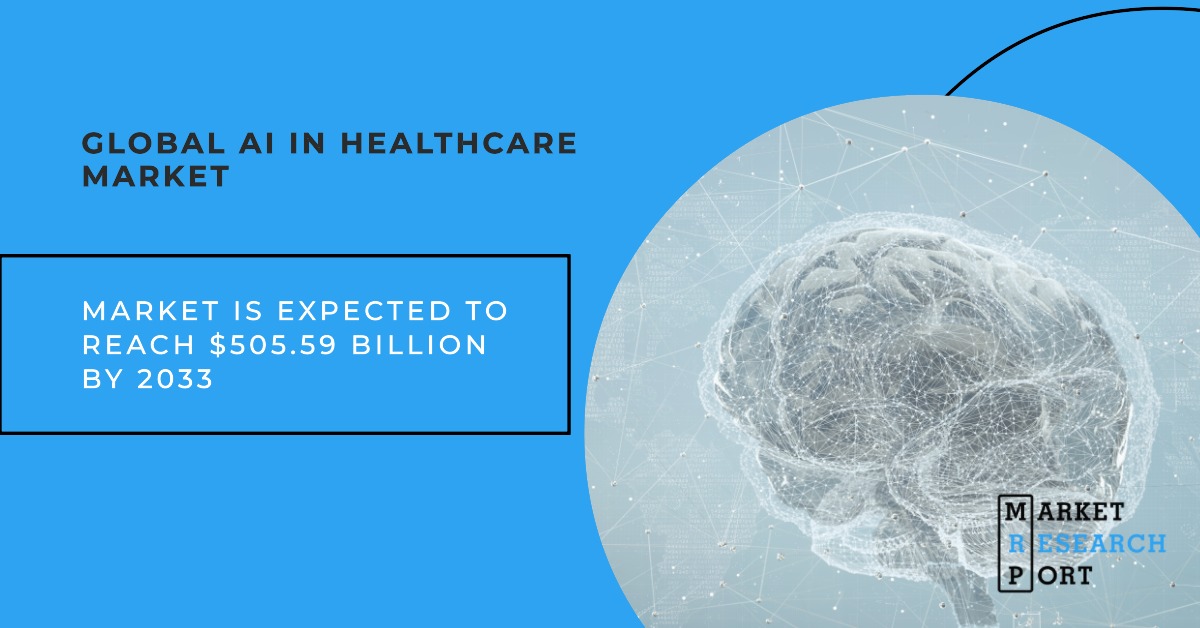
The AI in healthcare market size and forecast indicate robust long-term growth supported by widespread adoption of artificial intelligence across clinical, operational, and research workflows.
As of 2025, AI adoption across healthcare organizations has become mainstream, strengthening the growth trajectory of the AI in healthcare market. A large share of healthcare institutions are actively implementing AI-driven technologies to improve diagnostic accuracy, accelerate clinical decision-making, and enhance patient engagement.
The exponential rise in healthcare data generated from electronic health records (EHRs), medical imaging platforms, wearable devices, and genomic sequencing has further increased demand for AI-powered systems capable of transforming complex datasets into actionable clinical insights.
The ongoing shortage of healthcare professionals continues to drive adoption across the AI in healthcare market. In 2025, healthcare providers increasingly rely on AI and machine learning solutions to support diagnostics, automate administrative tasks, optimize workflows, and maintain quality of care amid staffing constraints.
The AI in healthcare industry remains highly fragmented, with numerous global and regional players launching innovative solutions. Continuous advancements in machine learning, deep learning, natural language processing, and computer vision are accelerating innovation across the AI in healthcare market.
Mergers and acquisitions continue to reshape the competitive landscape, allowing companies to enhance technological capabilities and expand market reach. Regulatory frameworks such as HIPAA and GDPR play a critical role in governing AI deployment and ensuring patient data security.
Software solutions dominated the AI in healthcare market in 2025, accounting for more than 46% of total revenue. This dominance is attributed to increased adoption of AI platforms, APIs, and machine learning frameworks across hospitals, pharmaceutical companies, and healthcare payers.
The services segment is expected to grow at the fastest CAGR over the forecast period, supported by rising demand for system deployment, integration, support, maintenance, and regulatory compliance services.
Robot-assisted surgery remained the leading application segment within the AI in healthcare market, benefiting from increased use of AI-driven surgical planning, robotic navigation, and precision-based interventions.
Fraud detection is anticipated to witness the fastest growth from 2025 to 2033, driven by rising healthcare fraud cases and increased deployment of AI-based real-time analytics in claims management.
Pharmaceutical and biotechnology companies continued to dominate the AI in healthcare market by end use, leveraging AI technologies to accelerate drug discovery, optimize clinical trials, and advance precision medicine initiatives.
Healthcare providers, including hospitals and outpatient facilities, are expected to register strong growth as AI-powered diagnostic imaging, predictive analytics, and resource optimization solutions become integral to care delivery.
Machine learning accounted for the largest share of the AI in healthcare market by technology in 2025, driven by its ability to analyze complex datasets and deliver predictive insights for diagnosis, prognosis, and treatment planning.
Context-aware computing is projected to grow at the fastest rate, as AI systems increasingly integrate real-time patient data, medical history, and environmental factors to enable personalized care delivery.
North America continued to dominate the AI in healthcare market in 2025, supported by advanced healthcare IT infrastructure, high healthcare spending, favorable government initiatives, and strong AI adoption across healthcare systems.
Europe is expected to experience steady growth due to rising public and private investments in AI-enabled healthcare initiatives, particularly in the UK and Western Europe.
The Asia Pacific region is anticipated to witness rapid expansion in the AI in healthcare market, driven by digital transformation, supportive government policies, and increasing investments in AI-focused healthcare startups.
Overall, the AI in Healthcare Market is expected to undergo transformative growth as artificial intelligence becomes a foundational technology across global healthcare ecosystems.
This report forecasts revenue growth at the global, regional, and country levels and provides a detailed analysis of industry trends across each sub-segment from 2021 to 2033. The global AI in healthcare market is segmented based on component, application, technology, end use, and region.