
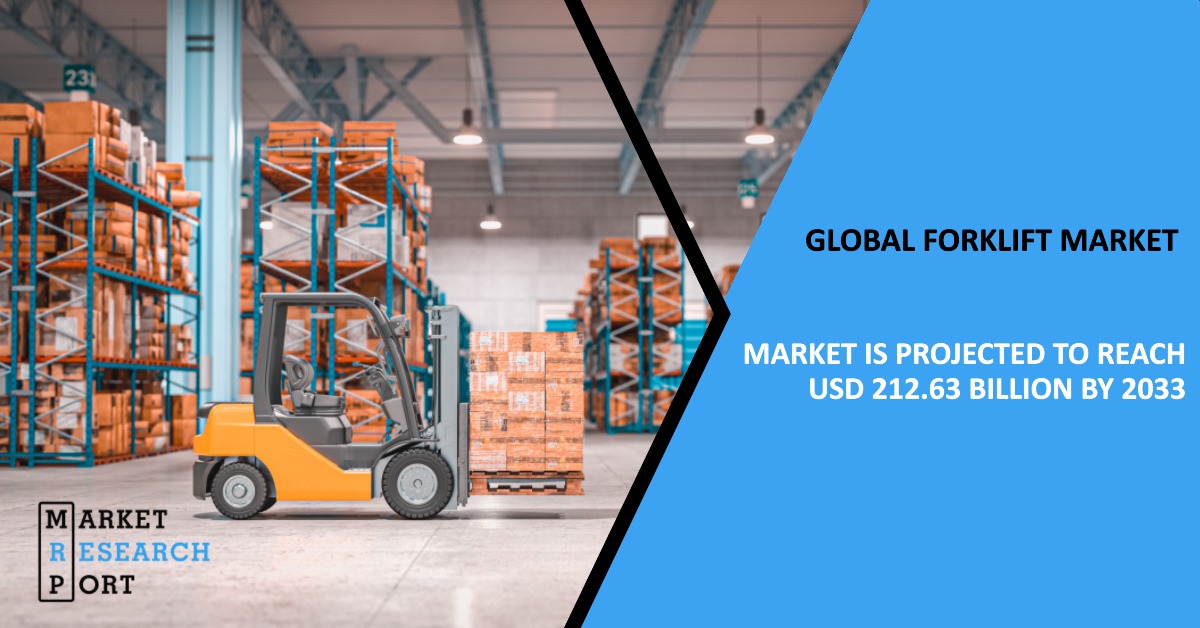
The global forklift market represents a critical component of the material handling and logistics ecosystem, supporting efficient movement, storage, and management of goods across industries. In 2025, the global forklift market was valued at approximately USD 81.44 billion and is projected to expand significantly, reaching USD 212.63 billion by 2033. This robust growth reflects a compound annual growth rate (CAGR) of 12.7% from 2026 to 2033, driven by accelerating industrial automation, expansion of e-commerce infrastructure, and a global shift toward sustainable material handling solutions.
Forklifts are indispensable across warehouses, manufacturing plants, ports, airports, and distribution centers. As supply chains become more complex and time-sensitive, businesses are increasingly investing in advanced forklifts to improve productivity, reduce downtime, and ensure safe material movement. The industry is currently undergoing a major transformation, marked by electrification, digitalization, and automation.
One of the primary growth drivers for the forklift market is the rapid transition from diesel and LPG-powered forklifts to electric alternatives. Rising fuel costs, tightening emissions regulations, and corporate sustainability commitments are compelling organizations to adopt cleaner and more energy-efficient equipment. Electric forklifts provide quieter operation, lower maintenance costs, and zero on-site emissions, making them ideal for indoor and warehouse applications.
Another key driver is the explosive growth of e-commerce and omnichannel retail. The continuous expansion of fulfillment centers, last-mile delivery hubs, and high-density warehouses has created strong demand for forklifts capable of operating efficiently in confined spaces and high-throughput environments. As consumer expectations for faster delivery increase, logistics providers are scaling up operations, fueling sustained forklift demand worldwide.
Automation is also reshaping the forklift industry. Autonomous and semi-autonomous forklifts equipped with LiDAR sensors, cameras, AI-based navigation systems, and fleet management software are gaining traction. These solutions help address labor shortages, enhance workplace safety, minimize human error, and support round-the-clock warehouse operations.
Despite strong growth prospects, the forklift market faces several challenges. One major restraint is the high upfront cost of modern forklifts, particularly electric, lithium-ion, and autonomous models. Small and mid-sized enterprises often struggle to justify the initial investment, especially in cost-sensitive markets.
Additionally, limited charging infrastructure and lack of technical expertise in emerging economies slow the adoption of advanced electric and autonomous forklifts. Supply chain disruptions, raw material price volatility, and long equipment lead times further affect market dynamics, creating operational challenges for manufacturers and end users alike.
Based on class, the Class 3 segment dominated the global forklift market in 2025, accounting for 45.3% of total revenue. Class 3 forklifts, commonly known as electric motorized hand trucks, are primarily used for low-lift and short-distance material movement. These forklifts are hand-controlled and offer excellent maneuverability, making them ideal for dense warehouse layouts and narrow aisles.
The Class 1 segment is expected to witness significant growth over the forecast period. Class 1 forklifts include electric rider trucks widely used in retail, food & beverage, chemical, and manufacturing industries. Their quiet operation, ease of maneuverability, and reduced maintenance needs make them well-suited for indoor environments where noise and space constraints are critical factors.
The electric forklift segment emerged as the dominant power source in 2025. Electric forklifts are increasingly favored due to their environmental benefits, improved energy efficiency, and advancements in battery technology. Modern electric forklifts offer longer operating hours, faster charging, and improved performance, making them viable replacements for internal combustion engine (ICE) models in many applications.
The ICE forklift segment continues to play a vital role in heavy-duty outdoor applications, including ports, construction sites, and large industrial yards. ICE forklifts are valued for their high torque, durability, and ability to operate continuously without charging downtime. However, growing regulatory pressure and rising fuel costs are gradually limiting their long-term growth potential.
Forklifts with a 5–15 ton load capacity dominated the market in 2025. These forklifts are widely used for handling pallets, steel, bricks, and heavy industrial materials. Their versatility allows them to operate both indoors and outdoors, supporting applications across manufacturing, construction, and logistics.
The below 5 ton segment is expected to grow at the fastest CAGR during the forecast period. Compact forklifts in this category are ideal for warehouses with limited floor space, enabling safe and efficient handling of smaller loads while improving workforce safety and operational flexibility.
The lead-acid battery segment held the largest share of the electric forklift market in 2025. Lead-acid batteries remain popular due to their reliability, affordability, and ability to deliver high current output required for heavy lifting operations.
In contrast, the lithium-ion battery segment is expected to witness the fastest growth over the forecast period. Lithium-ion batteries offer faster charging, longer service life, minimal maintenance, and improved energy efficiency. Their environmentally friendly profile aligns with global sustainability goals, making them increasingly attractive for modern forklift fleets.
The industrial segment dominated the forklift market in 2025. Forklifts play a critical role in manufacturing facilities by enabling efficient movement of raw materials, work-in-progress inventory, and finished goods. Their ability to handle heavy loads and operate in confined spaces enhances production efficiency and reduces bottlenecks.
The retail & e-commerce segment is expected to register the fastest growth during the forecast period. Rapid expansion of online retail, growing consumer demand for fast delivery, and increasing warehouse automation are driving forklift adoption across fulfillment and distribution centers worldwide.
Asia Pacific dominated the global forklift market in 2025, accounting for 49.0% of total revenue. The region benefits from strong manufacturing activity, expanding logistics infrastructure, and the presence of leading forklift manufacturers. China and Japan are key markets, driven by smart manufacturing initiatives, automation adoption, and sustainability policies.
Europe is expected to witness moderate growth during the forecast period. Stringent environmental regulations, increasing adoption of electric forklifts, and growth in e-commerce are shaping the regional market. Countries such as Germany and the UK lead demand due to advanced industrial and logistics sectors.
North America continues to experience strong forklift demand driven by warehouse expansion, automation, and sustainability initiatives. The United States remains the largest market in the region, supported by rapid growth in e-commerce and investment in autonomous material-handling technologies.