The AI Data Center Market is experiencing rapid expansion as artificial intelligence (AI) continues to transform industries worldwide. AI-optimized data centers are specialized infrastructure facilities designed to support machine learning (ML), deep learning, generative AI, high-performance computing (HPC), and large-scale data processing workloads.
As enterprises integrate AI-driven automation, predictive analytics, robotics, and intelligent decision-making systems, demand for high-density GPU clusters and AI accelerators has surged. AI data centers serve as the foundational infrastructure powering cloud AI platforms, enterprise AI deployments, autonomous systems, smart cities, and next-generation digital ecosystems.
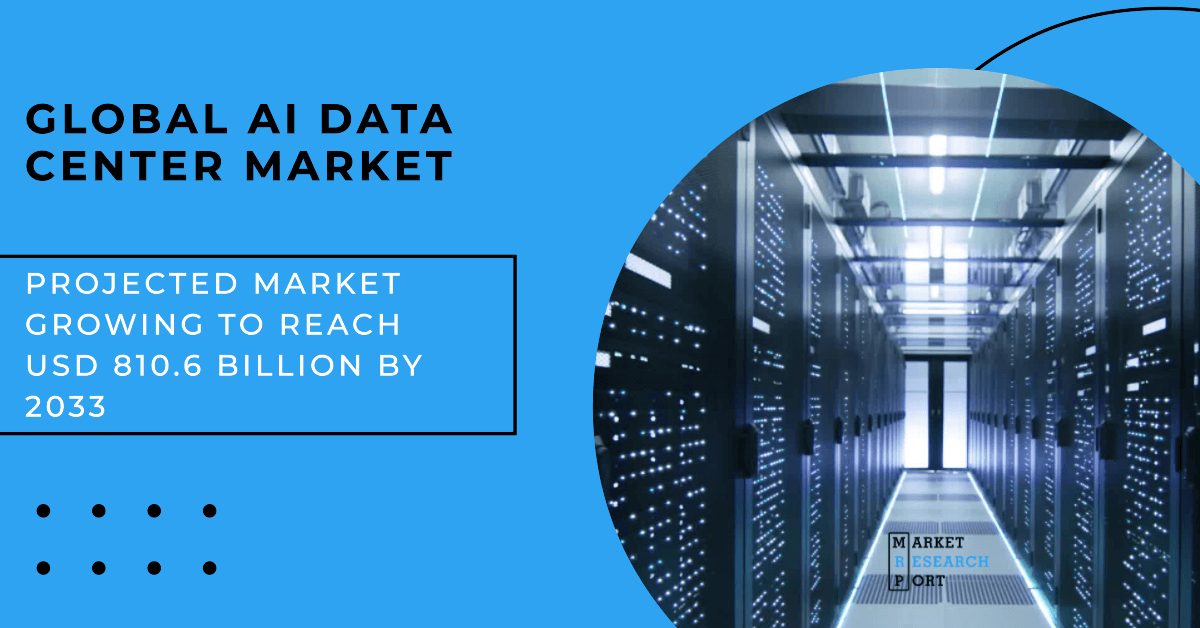
The global AI data center market size was valued at USD 147.3 billion in 2024 and is projected to reach USD 810.6 billion by 2033, expanding at a robust CAGR of 23.9% during 2026–2033.
The exponential growth trajectory is supported by hyperscale cloud investments, enterprise AI adoption, semiconductor innovation, and the continued expansion of generative AI applications across industries.
| Year | Market Value (USD Billion) | Growth Stage |
|---|---|---|
| 2024 (Base Year) | 147.3 | Early AI infrastructure expansion |
| 2026 (Estimated) | 225–240 | Accelerated hyperscale investments |
| 2030 (Estimated) | 500+ | Mainstream enterprise AI adoption |
| 2033 (Forecast) | 810.6 | AI-dominant infrastructure ecosystem |
An AI data center is a purpose-built computing facility optimized for AI model training, inference processing, and large-scale data analytics. Unlike traditional cloud data centers, AI facilities support:
These facilities enable organizations to train massive large language models (LLMs), deploy generative AI platforms, and support real-time AI decision systems at scale.
Generative AI platforms, including conversational AI, image generation, code automation, and predictive analytics, require enormous computational power. The increasing size of AI models has significantly raised demand for high-density GPU clusters and specialized AI accelerators.
Global cloud providers are investing billions of dollars into AI-ready campuses. Multi-gigawatt AI data center facilities equipped with custom silicon and advanced cooling systems are becoming the backbone of cloud AI services.
Industries such as BFSI, healthcare, retail, telecom, automotive, and manufacturing are embedding AI into mission-critical operations. This drives demand for private AI infrastructure, hybrid cloud AI solutions, and edge AI data centers.
Modern AI racks exceed 150–250 kW density, requiring direct-to-chip liquid cooling and immersion cooling technologies. These innovations enable higher compute efficiency while reducing operational energy costs.
With rising energy consumption, AI data centers are integrating renewable energy, battery storage, and AI-powered energy optimization tools to improve sustainability and regulatory compliance.
| Trend | Description | Impact |
|---|---|---|
| High Rack Density | 150–250+ kW AI racks | Supports large AI model training |
| Liquid Cooling Adoption | Direct-to-chip & immersion cooling | Improves thermal efficiency |
| Custom AI Chips | ASICs & AI accelerators | Optimizes performance per watt |
| Edge AI Infrastructure | Distributed AI micro data centers | Reduces latency |
| Renewable Energy Integration | Solar, wind, microgrids | Improves sustainability |
North America dominates the AI data center market due to strong hyperscale investments, semiconductor innovation ecosystems, and advanced digital infrastructure.
Asia-Pacific is expected to register the fastest growth rate, driven by rapid cloud adoption, sovereign AI programs, and large-scale infrastructure investments.
Europe emphasizes green AI data centers, regulatory compliance, and sustainable digital infrastructure development.
Strategic sovereign AI initiatives and smart city projects are contributing to AI data center capacity expansion in emerging regions.
The AI data center market is highly competitive and capital-intensive. Leading technology providers are focusing on custom AI silicon, advanced networking, liquid cooling solutions, and sustainable infrastructure innovation.
The AI Data Center Market is poised for sustained double-digit growth through 2033. As AI becomes deeply embedded into enterprise operations and consumer applications, next-generation data centers will prioritize performance, scalability, and energy efficiency.
With market value projected to exceed USD 810 billion by 2033, AI infrastructure will remain central to digital transformation strategies worldwide. Companies that invest in advanced cooling, renewable energy integration, and AI-specific hardware architectures are expected to lead the evolving market landscape.
The AI data center market is primarily driven by the rapid adoption of generative AI, machine learning, and high-performance computing (HPC) workloads. Increasing enterprise AI integration, hyperscale cloud expansion, rising demand for GPU clusters, and investments in sovereign AI infrastructure are significantly accelerating global market growth.
The global AI data center market was valued at USD 147.3 billion in 2024 and is projected to reach approximately USD 810.6 billion by 2033, growing at a CAGR of 23.9% during the forecast period 2026–2033. This growth reflects increasing AI infrastructure investments worldwide.
AI data centers are purpose-built to handle high-density GPU workloads, AI accelerators, and advanced cooling systems. Unlike traditional facilities, they support liquid cooling, ultra-low latency networking, AI-optimized hardware, and significantly higher rack power densities to accommodate large-scale AI model training.
North America currently dominates the AI data center market due to major hyperscale investments and semiconductor ecosystem strength. However, Asia-Pacific is expected to register the fastest CAGR during 2026–2033, driven by sovereign AI initiatives and rapid digital transformation across emerging economies.
Leading companies operating in the AI data center market include NVIDIA, AMD, Intel, Microsoft, Google, Amazon Web Services (AWS), Meta Platforms, Dell Technologies, Hewlett Packard Enterprise (HPE), Cisco Systems, and IBM. These players are actively investing in AI infrastructure, custom silicon, and high-performance networking technologies.