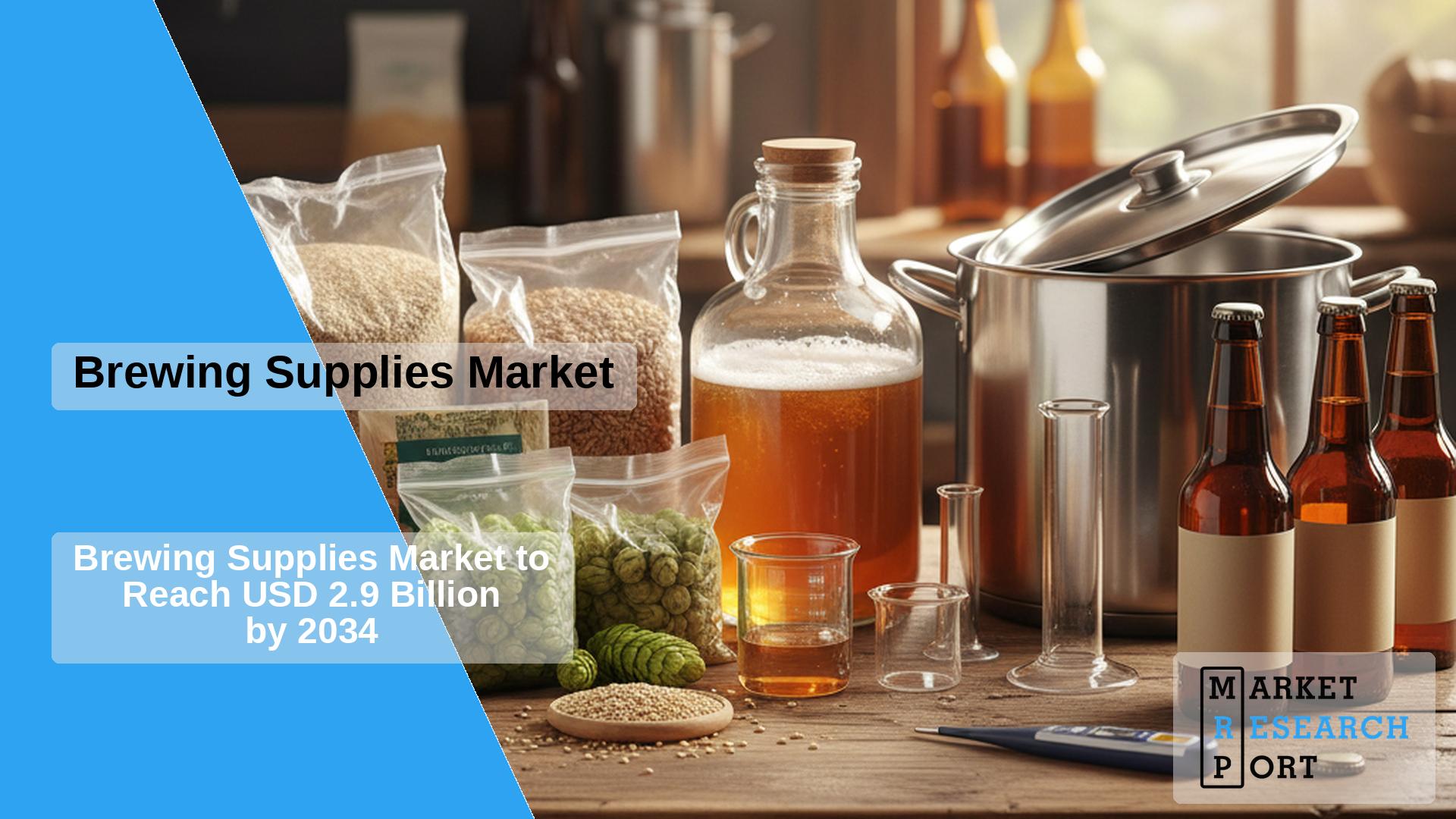
The global brewing supplies market is projected to reach approximately USD 1.6 billion in 2025 and is expected to expand steadily to nearly USD 2.9 billion by 2034, registering a compound annual growth rate of around 6.5% over the forecast period.
The market includes essential ingredients, processing equipment, and brewing systems required for beer production across commercial breweries, craft brewers, and homebrewing setups. Demand is supported by rising interest in craft beverages, small-batch production, and innovation in brewing techniques.
Fermentation equipment continues to represent the most critical component of brewing infrastructure due to its direct impact on alcohol content, flavor development, and quality consistency. Commercial brewing applications account for the majority of demand, driven by expanding craft breweries and brewpub formats globally.
Fermentation systems dominate the product landscape, supported by increasing investment in temperature-controlled and automated brewing solutions. Brew house units and filtration systems also show consistent demand as breweries prioritize efficiency, hygiene, and output stability.
Commercial brewing remains the primary application area, driven by the expansion of microbreweries, taprooms, and regional craft brands. Industrial-scale brewing supports stable demand through large-volume production and standardized supply chains.
Nano and microbreweries continue to shape market demand due to low entry barriers and localized consumption trends. Larger industrial breweries focus on long-term investments in high-capacity, energy-efficient systems.
The growing popularity of craft beer, homebrewing culture, and demand for customized beverage profiles continues to drive market expansion. Easy access to brewing knowledge, ingredient variety, and modular equipment supports repeat purchases and equipment upgrades.
High upfront investment costs for professional-grade brewing systems remain a challenge, particularly for startups and small-scale operators. Regulatory compliance and fluctuating raw material prices further influence purchasing decisions.
Rising demand for non-alcoholic and low-alcohol beverages is encouraging breweries to adopt specialized brewing processes. Additionally, the growth of online distribution channels is improving access to brewing supplies for hobbyists and small producers.
Automation, digital monitoring, and smart fermentation controls are gaining traction across both commercial and homebrewing environments. Sustainability-focused equipment, water-efficient systems, and reusable materials are increasingly influencing supplier and buyer preferences.
North America remains the leading regional market in 2025, supported by a mature craft beer ecosystem and strong consumer demand for specialty beverages. Europe continues to benefit from traditional brewing heritage combined with modern production upgrades, while Asia Pacific shows accelerating growth driven by urbanization and changing consumer preferences.
Leading brewing supply manufacturers focus on process efficiency, hygiene standards, scalability, and energy optimization. These companies support breweries across varying production scales while enabling consistent quality and operational reliability.
In early 2025, multiple global brewing equipment manufacturers announced capacity expansion initiatives to support rising demand from craft and low-alcohol beer producers. Investments focused on advanced fermentation technology, automation upgrades, and sustainability-driven brewing solutions.
Market growth is driven by expanding craft beer culture, rising homebrewing adoption, innovation in brewing technology, and increasing demand for customized beverage profiles.
Fermentation systems hold the largest market share due to their critical role in quality control, alcohol formation, and flavor consistency.
North America leads the market, supported by a strong network of microbreweries, homebrewers, and established commercial brewing operations.
Sustainability trends are driving demand for energy-efficient systems, water-saving technologies, and environmentally responsible brewing equipment.