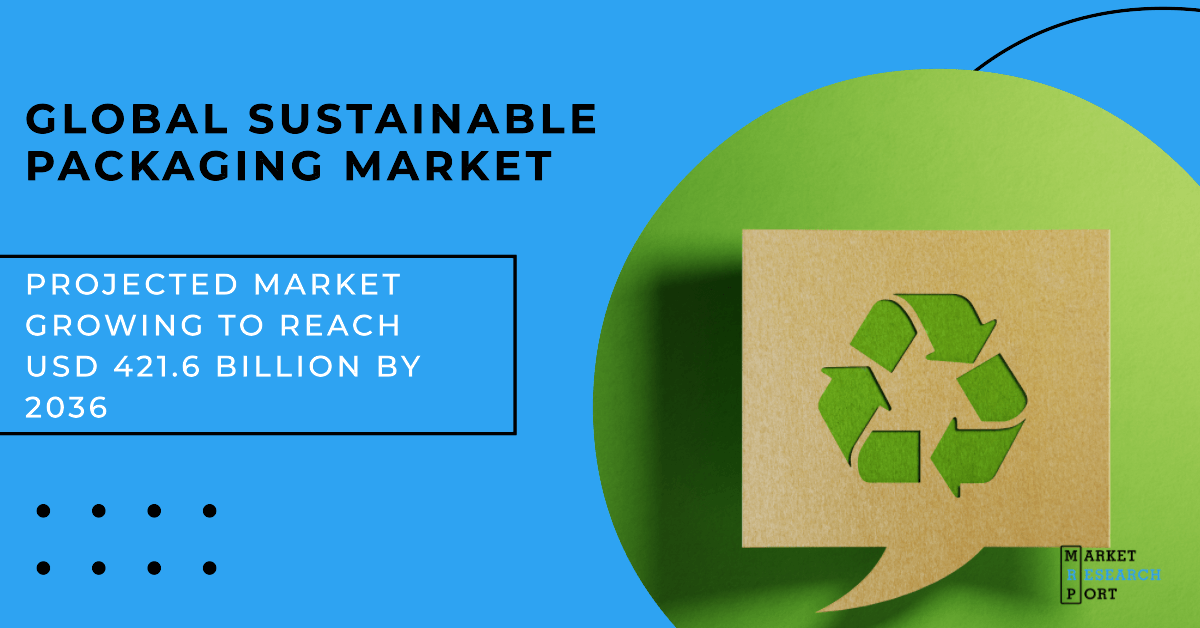
The global sustainable packaging market is projected to witness consistent expansion throughout the forecast timeline, driven by regulatory enforcement and rising environmental responsibility across industries. Market valuation is estimated at USD 267.3 billion in 2026 and is forecast to increase to nearly USD 421.6 billion by 2036, registering a compound annual growth rate (CAGR) of 4.7%. Growth momentum is supported by increasing demand for eco-friendly packaging in food, consumer goods, healthcare, and industrial supply chains.
Escalating restrictions on single-use plastics, coupled with global waste reduction initiatives, are accelerating the shift toward recyclable, biodegradable, and renewable packaging solutions. Manufacturers are increasingly aligning packaging strategies with sustainability mandates to ensure long-term compliance and brand credibility.
Government authorities worldwide have introduced strict regulations focused on minimizing packaging waste, improving recyclability, and controlling material composition. Sustainable packaging materials must undergo standardized testing, certification, and regulatory verification before being approved for commercial use, import, or distribution.
Compliance with national and international sustainability benchmarks is mandatory for manufacturers. These benchmarks define acceptable thresholds for biodegradability, compostability, recycled content, and renewable material usage, ensuring packaging performance aligns with environmental protection objectives while maintaining product safety.
Environmental compliance also extends to raw material sourcing, production processes, and end-of-life disposal. Packaging solutions must meet ecological safety standards to limit environmental impact during manufacturing and post-consumption stages.
International trade in sustainable packaging is supported by strong production capabilities across Europe, Asia, and North America. Germany stands out as a major exporter due to advanced environmental technologies, mature regulatory systems, and high manufacturing standards.
China and the United States contribute significantly to global exports, supplying large volumes of recyclable and biodegradable packaging solutions. Brazil plays a growing role by leveraging renewable material technologies, while several European nations support exports through specialized sustainable packaging production.
On the import front, countries with expanding green consumer markets and food processing industries represent major demand centers. India imports substantial volumes to support food and beverage sector growth, while the United States and Germany supplement domestic supply with specialized sustainable packaging formats.
Market adoption is influenced by regulatory compliance, cost efficiency, material availability, and functional performance. Segmentation by material type, product format, and end-use industry highlights how manufacturers optimize packaging solutions to meet environmental and operational requirements.
Material selection is guided by biodegradability standards, regulatory compliance, and application-specific performance needs.
Product format selection depends on storage, transportation, protection, and environmental impact considerations.
Rising sustainability commitments among manufacturers and retailers are driving adoption across food processing, personal care, healthcare, and consumer goods industries. Packaging solutions are increasingly evaluated for recyclability, lifecycle impact, and compatibility with existing production systems.
Manufacturers focus on ensuring consistent performance across logistics, storage, and disposal while minimizing environmental footprint throughout the supply chain.
| Country | CAGR (2026–2036) |
|---|---|
| India | 6.2% |
| China | 5.8% |
| Brazil | 5.1% |
| Germany | 4.3% |
| United States | 4.0% |
The sustainable packaging market is moderately competitive, with companies focusing on material innovation, regulatory compliance, and scalable production. Leading players invest in renewable materials and recyclable packaging technologies to strengthen global presence.
| Category | Details |
|---|---|
| Market Units | USD Billion |
| Material Types | Bio-based, Recycled Content, Renewable Materials, Others |
| Product Types | Flexible, Rigid, Paperboard, Glass, Others |
| End-Use Industries | Food & Beverage, Personal Care, Healthcare, Consumer Goods, Others |
| Regions | Asia Pacific, Europe, North America, Latin America, Middle East & Africa |
The market is valued at USD 267.3 billion in 2026 and is expected to reach approximately USD 421.6 billion by 2036, growing at a CAGR of 4.7%.
Key growth drivers include environmental regulations, waste reduction initiatives, and rising demand for recyclable and biodegradable packaging solutions.
Bio-based packaging holds the largest share due to its renewable sourcing, biodegradability, and widespread use in food and consumer goods.
Regulations enforce recyclability standards, material composition limits, and mandatory certification, ensuring environmental compliance across industries.
Asia Pacific leads growth, particularly in India and China, followed by Brazil, Germany, and the United States.