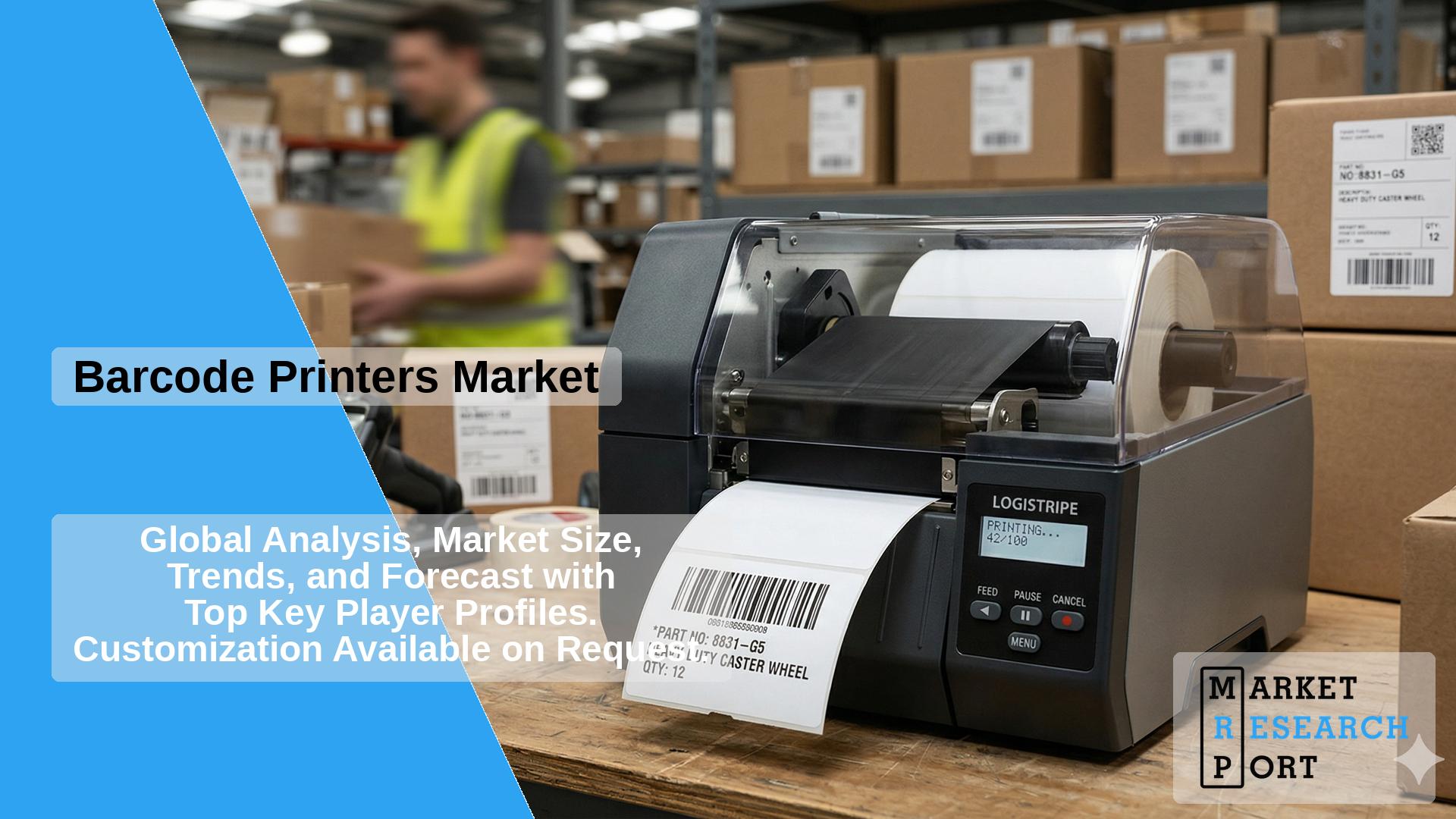
The global barcode printers market size is estimated at USD 5,240.5 million in 2026 and is projected to reach USD 10,815.2 million by 2036, growing at a CAGR of 7.5% from 2026 to 2036. This expansion is primarily driven by the rapid growth of e-commerce, the increasing need for efficient supply chain management, and the rising adoption of automated identification and data capture (AIDC) technologies across various industrial sectors. The integration of Internet of Things (IoT) and cloud-based printing solutions has further revolutionized the market, allowing for real-time tracking and enhanced operational transparency.
The global landscape for barcode printing is undergoing a significant transformation as businesses transition from manual record-keeping to automated, digital systems. The surge in global trade and the complexity of modern supply chains necessitate highly accurate tracking mechanisms. Barcode printers serve as the foundational hardware for this tracking, enabling the creation of labels that can withstand various shipping conditions. Furthermore, the rise of omnichannel retailing has forced retailers to adopt sophisticated inventory management systems, where barcode printers play a critical role in ensuring that stock levels are accurately reflected across both physical and digital storefronts.
Technological advancements have led to the development of more compact, energy-efficient, and user-friendly printing devices. The shift toward mobile and wireless printing is particularly noteworthy, as it allows workers in warehouses and retail floors to generate labels at the point of application, significantly reducing errors and improving productivity. Additionally, the integration of RFID (Radio Frequency Identification) capabilities into barcode printers is a growing trend, providing a dual-layer of tracking that combines the visual reliability of barcodes with the automated scanning efficiency of RFID tags.
Despite the positive outlook, the market faces challenges such as high initial investment costs for high-end industrial printers and the ongoing maintenance requirements associated with thermal printheads. Furthermore, the increasing popularity of digital alternatives, such as QR codes displayed on screens or direct-to-part marking in some manufacturing niches, could potentially limit the growth of traditional label printing in specific applications. However, the versatility and cost-effectiveness of physical labels continue to make barcode printers an indispensable tool for the majority of global industries.
The barcode printers market is characterized by a moderate to high level of concentration, with a few prominent global players holding a substantial portion of the market share. Companies like Zebra Technologies, Honeywell, and SATO Holdings dominate the landscape through extensive product portfolios, global distribution networks, and significant investments in research and development. These leaders often engage in strategic acquisitions to integrate software capabilities, such as cloud-based printer management and analytics, into their hardware offerings, creating a more holistic value proposition for end-users.
Innovation in this market is focused on enhancing connectivity and durability. Modern printers are increasingly equipped with advanced sensors that monitor printhead health and media levels, reducing downtime through predictive maintenance. The market is also seeing a shift toward sustainable labeling solutions, with manufacturers developing printers that can handle linerless labels, which reduce waste and lower shipping costs. Regulatory compliance, particularly in the pharmaceutical and food and beverage sectors, remains a primary driver for market characteristics, as printers must meet specific standards for label clarity and longevity to ensure consumer safety.
The industrial barcode printers segment accounted for a significant revenue share in 2026. These machines are designed for high-volume, continuous operation in demanding environments such as factories and large distribution centers. Their robust construction, often featuring metal frames and high-capacity ribbon rolls, allows them to operate 24/7 with minimal intervention. The demand in this segment is driven by the manufacturing sector’s move toward Industry 4.0, where every component and finished good must be uniquely identified for traceability and quality control.
The mobile barcode printers segment is projected to grow at the highest CAGR during the forecast period. The proliferation of on-demand labeling in logistics and retail is the primary catalyst for this growth. Mobile printers allow workers to print labels for shelf edges, price markdowns, or shipping tags directly where they are needed, eliminating the time spent walking back and forth to a stationary printer. Improvements in battery life, wireless connectivity (Bluetooth and Wi-Fi), and ruggedized designs that can survive drops onto concrete have made these devices essential for modern workforce mobility.
Desktop barcode printers remain a staple for small to medium-sized businesses and office environments. These printers offer a balance of performance and affordability, making them ideal for lower-volume applications such as shipping small parcels, asset tracking in offices, and printing patient wristbands in clinics. Their compact footprint allows them to fit easily on desks or counters, and the increasing ease of setup through smartphone apps has lowered the barrier to entry for smaller enterprises looking to professionalize their labeling processes.
Thermal transfer technology led the market in 2026, accounting for the largest share of revenue. This technology uses a heated ribbon to produce durable, long-lasting images on a wide variety of materials, including paper, polyester, and synthetic films. Labels produced via thermal transfer are resistant to heat, chemicals, and abrasion, making them the standard for automotive parts, chemical drums, and outdoor applications. The versatility of this technology ensures its continued dominance as industries seek labeling solutions that can survive the entire product lifecycle.
Direct thermal printing is another significant segment, favored for its simplicity and lower operational costs, as it does not require a ribbon. Instead, it uses heat-sensitive media that blackens when passing under the printhead. While direct thermal labels are sensitive to light and heat over time, they are perfect for short-term applications such as shipping labels, grocery receipts, and event tickets. The growth of the e-commerce sector, which relies heavily on high-speed printing of short-lived shipping tags, continues to drive demand for direct thermal printers.
Inkjet and laser barcode printing technologies represent smaller but specialized segments. Inkjet barcode printers are increasingly used for high-resolution color labeling, allowing brands to combine regulatory barcodes with vibrant marketing graphics on a single label. This is particularly popular in the specialty food and cosmetic industries. Laser printers, while less common for dedicated label printing, are used in high-speed document processing environments where barcodes are integrated into invoices or packing slips.
The transportation and logistics segment is the largest application area for barcode printers. The global supply chain relies on barcodes for every stage of the journey, from pallet labeling in the warehouse to last-mile delivery tracking. The rise of e-commerce has exponentially increased the volume of packages moving through global networks, necessitating faster and more reliable printing solutions. Logistics providers are increasingly adopting mobile printers to streamline cross-docking and sorting operations, ensuring that every item is correctly routed in real-time.
The retail segment is a major consumer of barcode printers, utilizing them for inventory management, price labeling, and point-of-sale operations. In the modern retail environment, accuracy is paramount to support buy-online-pickup-in-store (BOPIS) models. Retailers use desktop and mobile printers to ensure that every item on the shelf is correctly tagged and that inventory counts remain accurate across all channels. Additionally, the use of barcode printers for loyalty cards and promotional coupons continues to be a standard practice in the industry.
Healthcare is expected to be the fastest-growing application segment. The need for patient safety and the prevention of medical errors have led to strict regulations regarding the labeling of medications, laboratory samples, and patient wristbands. Barcode printers in healthcare must often meet specific hygiene standards and be capable of printing very small, high-resolution codes on vials and slides. The implementation of the Unique Device Identification (UDI) system for medical devices globally has further boosted the demand for high-precision barcode printing in this sector.
Manufacturing applications focus on work-in-progress (WIP) tracking and finished goods labeling. In industries such as electronics and aerospace, components must be tracked through complex assembly processes to ensure quality and compliance. Barcode printers used in these environments often need to produce labels that can withstand high temperatures or chemical washes. The integration of barcode printing with Enterprise Resource Planning (ERP) systems allows manufacturers to maintain a digital twin of their production floor, optimizing efficiency and reducing waste.
North America dominated the global barcode printers market in 2026. The region’s leadership is attributed to the presence of major industry players and a highly developed logistics infrastructure. The early adoption of advanced technologies in the retail sector and stringent regulatory frameworks in healthcare and food safety have created a mature market for barcode solutions. Furthermore, the rapid expansion of automated warehouses in the United States, driven by major e-commerce giants, continues to fuel the demand for both industrial and mobile printing hardware.
Europe follows closely, with a strong emphasis on traceability and sustainability. European regulations regarding food labeling and pharmaceutical tracking are among the strictest in the world, mandating the use of high-quality barcode printing. The region is also a leader in the adoption of linerless labeling technology as part of its broader environmental initiatives. Countries like Germany, the UK, and France are key hubs for manufacturing and logistics, providing a steady demand for high-performance industrial printers.
Asia Pacific is slated to experience the most rapid growth through 2036. This growth is powered by the massive manufacturing bases in China, India, Vietnam, and South Korea. As these nations modernize their industrial sectors and adopt international standards for export, the demand for barcode printers has surged. Additionally, the explosion of e-commerce in the region, particularly in China and Southeast Asia, has led to a significant investment in logistics technology. The rising middle class in these countries is also driving retail growth, further expanding the market for desktop and mobile printing solutions.
Latin America and the Middle East & Africa are emerging markets with significant potential. In Latin America, the growth is driven by the modernization of the retail sector and the expansion of the agricultural export industry, which requires standardized labeling for international trade. In the Middle East, investments in logistics hubs and the diversification of economies away from oil are creating new opportunities for industrial automation and barcode technology. Africa’s market growth is linked to the improving retail infrastructure and the increasing need for pharmaceutical tracking to combat counterfeit medicines.
The competitive environment is defined by continuous innovation and a shift toward software-integrated hardware. Leading companies are focusing on making printers easier to manage remotely, especially for large-scale deployments across multiple geographic locations. There is also a significant trend toward developing ‘intelligent’ printers that can run apps directly on the device, reducing the need for a connected PC.
Zebra Technologies is a global leader, known for its extensive range of rugged industrial and mobile printers. The company has successfully transitioned into a solutions provider, offering software platforms like Link-OS that allow for seamless integration and management of printer fleets. Their focus on R&D has led to the development of advanced RFID printing and encoding solutions that are setting industry standards.
Honeywell International, through its acquisition of brands like Intermec and Datamax-O’Neil, has built a formidable presence in the market. Honeywell’s printers are often integrated into their broader ecosystem of scanners and mobile computers, providing a unified workflow for logistics and manufacturing customers. Their focus on ‘connected’ industrial solutions helps businesses minimize downtime through advanced diagnostics.
SATO Holdings Corporation, based in Japan, is a pioneer in the industry, having invented the first thermal transfer barcode printer. SATO focuses on ‘Auto-ID’ solutions that bridge the gap between the physical and digital worlds. Their printers are highly regarded for their precision and reliability, particularly in the healthcare and food sectors where accuracy is critical.
| Report Attribute | Details |
| Market size value in 2026 | USD 5,240.5 million |
| Revenue forecast in 2036 | USD 10,815.2 million |
| Growth rate | CAGR of 7.5% from 2026 to 2036 |
| Base year for estimation | 2025 |
| Historical data | 2020 – 2024 |
| Forecast period | 2026 – 2036 |
| Quantitative units | Revenue in USD million and CAGR from 2026 to 2036 |
| Report coverage | Revenue forecast, competitive landscape, growth factors, and technology trends |
| Segments covered | Product, Technology, Application, Region |
| Regional scope | North America; Europe; Asia Pacific; Latin America; Middle East & Africa |
| Country scope | U.S.; Canada; UK; Germany; France; China; India; Japan; Brazil; Saudi Arabia |
| Key companies profiled | Zebra Technologies; Honeywell; SATO Holdings; TSC Auto ID; Brother Industries; Toshiba TEC; Bixolon; GoDEX; Postek; Avery Dennison |
This report provides an in-depth analysis of the global barcode printers market, offering revenue forecasts and trend analysis for the following segments from 2026 to 2036:
Product Outlook (Revenue, USD Million, 2026 – 2036)
Technology Outlook (Revenue, USD Million, 2026 – 2036)
Application Outlook (Revenue, USD Million, 2026 – 2036)
Region Outlook (Revenue, USD Million, 2026 – 2036)
How big is the barcode printers market?
The global barcode printers market is estimated to be valued at USD 5,240.5 million in 2026 and is expected to reach USD 10,815.2 million by 2036.
What is the projected growth rate of the market?
The market is anticipated to grow at a compound annual growth rate (CAGR) of 7.5% from 2026 to 2036.
Which region is the largest market for barcode printers?
North America currently holds the largest market share due to its advanced logistics and retail infrastructure, though Asia Pacific is the fastest-growing region.
What are the main types of barcode printers?
The market is segmented into industrial, desktop, and mobile barcode printers. Industrial printers lead in volume, while mobile printers are seeing the fastest adoption.
What is the difference between thermal transfer and direct thermal printing?
Thermal transfer uses a ribbon to create durable, long-lasting labels, while direct thermal prints directly onto heat-sensitive paper, making it cheaper but less durable.
Which application segment is growing the fastest?
The healthcare segment is expected to grow at the fastest rate due to increasing regulations for patient safety and medication traceability.
Who are the leading players in this industry?
Key players include Zebra Technologies, Honeywell, SATO Holdings, TSC Auto ID, and Brother Industries, among others.
What is driving the demand for mobile barcode printers?
The need for on-demand labeling in warehouses and retail stores to improve efficiency and reduce errors is the primary driver for mobile printer growth.
How is e-commerce affecting the barcode printers market?
E-commerce has significantly increased the demand for shipping labels and tracking solutions, directly boosting the sales of both industrial and desktop printers.
Are there eco-friendly options in the barcode printers market?
Yes, manufacturers are increasingly developing printers that support linerless labels and use energy-efficient components to meet sustainability goals.