
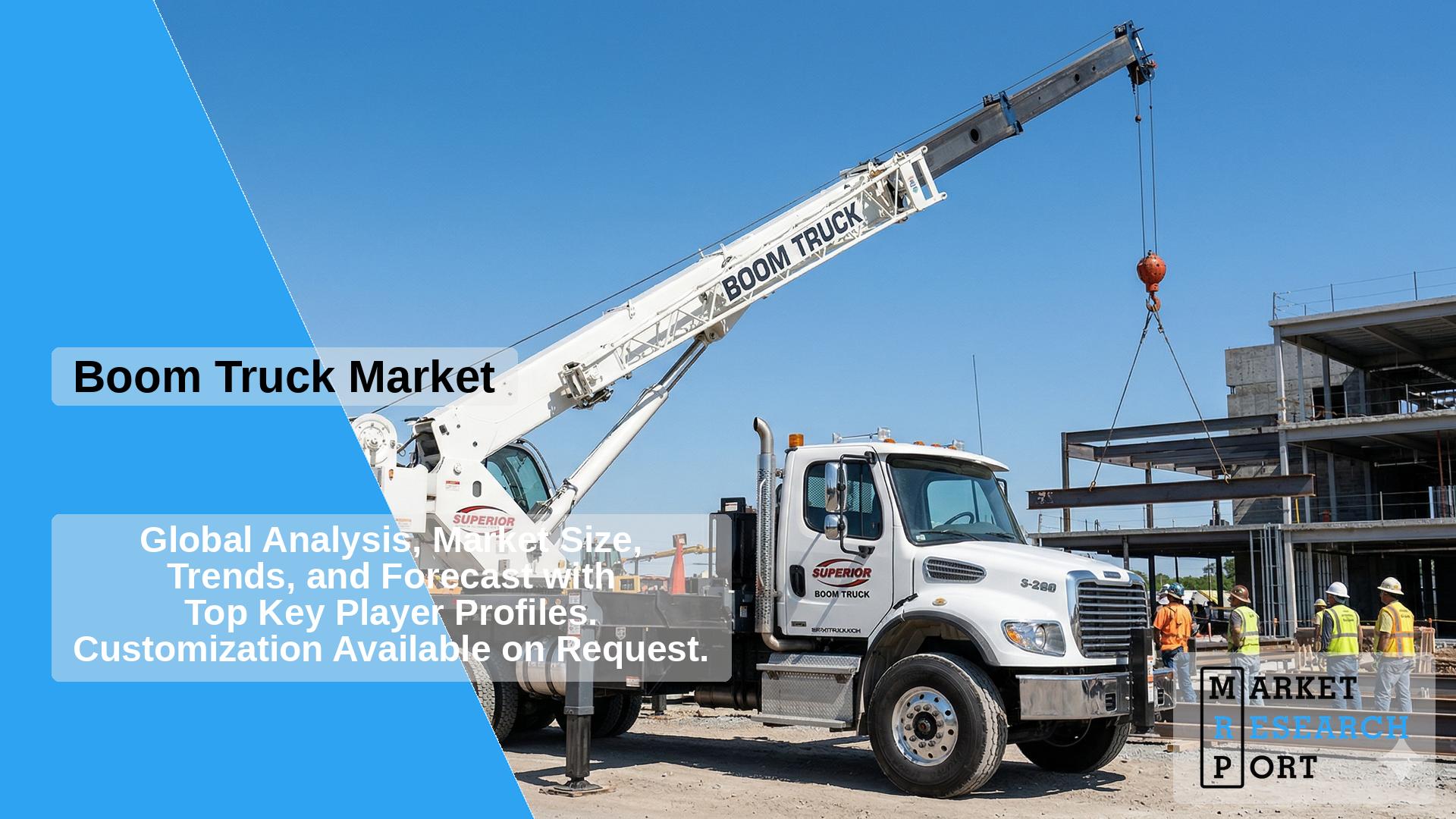
The global boom truck market size was valued at approximately USD 3,998.6 million in 2025 and is projected to reach USD 7,845.2 million by 2036, expanding at a compound annual growth rate (CAGR) of 6.3% from 2026 to 2036. The expansion of the market is primarily driven by the escalating demand for versatile lifting equipment in infrastructure development, the rapid rollout of telecommunications networks, and the essential maintenance requirements of aging utility grids globally. Boom trucks, which integrate the mobility of a commercial truck with the lifting capabilities of a crane, offer a unique value proposition in terms of operational efficiency and reduced setup times compared to traditional mobile cranes.
The global boom truck industry is undergoing a transformative phase characterized by the integration of advanced telematics, automation, and a shift toward sustainable power sources. As urban environments become more congested, the demand for compact yet powerful lifting solutions has surged. Boom trucks are increasingly preferred for their ability to travel at highway speeds and begin operations almost immediately upon arrival at a job site. This versatility is particularly critical for emergency utility repairs and fast-paced telecommunications installations, such as the global deployment of 5G infrastructure. Furthermore, technological improvements in hydraulic systems and high-strength steel have allowed manufacturers to increase lifting capacities without significantly increasing the vehicle’s footprint, making these machines indispensable for modern construction and maintenance tasks.
However, the market does face certain structural challenges, including high initial capital investment and the rising costs of raw materials such as steel and electronic components. The complexity of modern boom trucks, which now feature sophisticated load-moment indicators and remote-control systems, requires specialized operator training and higher maintenance expenditures. Additionally, stringent emission regulations in Europe and North America are forcing manufacturers to invest heavily in engine redesigns or hybrid-electric powertrains, which can temporarily inflate product prices. Supply chain disruptions and fluctuations in the global automotive sector also impact the availability of truck chassis, which are the foundational components for boom truck assemblies. Despite these hurdles, the long-term outlook remains positive as industrialization in emerging economies continues to drive demand for reliable lifting machinery.
Significant opportunities are emerging in the realm of electrification and digitalization. The development of electric boom trucks is gaining momentum, particularly for indoor applications or noise-sensitive urban areas where traditional diesel engines are restricted. These green alternatives not only reduce the carbon footprint of construction projects but also offer lower long-term operational costs. Moreover, the adoption of IoT-enabled telematics allows fleet managers to monitor equipment health in real-time, optimizing maintenance schedules and reducing downtime. As governments worldwide prioritize sustainable infrastructure and digital connectivity, the boom truck market is set to benefit from a steady stream of projects ranging from wind farm construction to the expansion of fiber-optic networks, ensuring a resilient growth trajectory through 2036.
The global boom truck market is moderately consolidated, with a few prominent players holding significant market shares while a variety of regional manufacturers cater to specific local needs. Major industry participants such as Altec Inc., Manitex International, and Palfinger AG lead the market through extensive distribution networks and a wide range of product offerings. these companies often engage in strategic partnerships with truck chassis manufacturers to ensure seamless integration of lifting components. The competitive landscape is defined by a focus on lifting capacity, boom length, and safety features. While global leaders dominate the high-capacity and specialized segments, regional players in markets like China and India are rapidly scaling their operations by offering cost-effective solutions for local infrastructure projects. This dynamic creates a competitive environment where innovation in safety and efficiency is paramount.
Market characteristics are defined by a strong emphasis on safety standards and regulatory compliance. Organizations such as OSHA in the United States and similar bodies globally mandate rigorous testing and certification for boom truck operators and equipment. This has led to the widespread adoption of advanced safety technologies, including outrigger monitoring systems, stability control, and precision load sensors. Additionally, the market is seeing a trend toward customization, where boom trucks are tailored for specific industries such as forestry, signage installation, or high-voltage electrical work. The integration of crane and aerial work platform functionalities into a single unit is another key characteristic, providing users with multifunctional tools that maximize return on investment. As the market moves toward 2036, the focus on operator comfort and ergonomic controls is also expected to increase, helping to mitigate the challenges posed by a shortage of skilled labor in the construction and utility sectors.
The telescopic boom segment dominated the market in 2025, accounting for a revenue share of approximately 62.4%. This dominance is attributed to the segment’s versatility and the ability of telescopic booms to extend and retract under load, which is essential for precision placement in complex construction environments. These trucks are widely used in the construction of commercial buildings, where they assist in lifting steel beams, HVAC units, and roofing materials. The ease of transport and the ability to navigate through narrow city streets make telescopic boom trucks the preferred choice for urban developers. Continuous improvements in hydraulic cylinder technology have enhanced the extension speed and load stability of these booms, further solidifying their market position. As infrastructure projects become more vertical and complex, the demand for telescopic units with higher reach and greater lifting capacity is expected to remain strong.
The stiff boom (or crane-style) segment is also a significant contributor to market revenue, particularly in the logistics and heavy-duty lifting sectors. Unlike telescopic booms, stiff booms are typically used for heavier, more straightforward lifting tasks where the boom remains at a fixed length during the lift. These units are prized for their durability and lower maintenance requirements compared to their telescopic counterparts. They are frequently employed in the oil and gas industry for moving heavy equipment and in the logistics sector for loading and unloading large cargo. While the growth rate for stiff booms is slightly lower than that of telescopic booms, they remain essential for industries that prioritize raw lifting power and structural rigidity over reach flexibility. Innovations in high-tensile steel have allowed for lighter stiff booms that can carry heavier loads, improving the overall efficiency of the truck chassis.
The utilities segment led the market in 2025, representing over 40% of the total revenue. This sector’s reliance on boom trucks is absolute, as they are used daily for the installation and repair of power lines, transformers, and street lighting. The global transition toward renewable energy has necessitated the construction of new transmission lines and the maintenance of existing grids, driving consistent demand for insulated boom trucks that can safely operate near high-voltage equipment. In addition, the increasing frequency of extreme weather events has led to a surge in emergency repair work, where the mobility and rapid deployment capabilities of boom trucks are vital. As utility companies prioritize grid modernization and the integration of smart technologies, the demand for specialized boom trucks equipped with advanced diagnostic tools and aerial buckets is expected to grow significantly through 2036.
The construction application segment is projected to grow at the fastest CAGR of 6.7% from 2026 to 2036. This growth is fueled by the global boom in residential and commercial real estate, particularly in emerging economies across Asia and Africa. Boom trucks are utilized in construction for a variety of tasks, including material handling, personnel lifting, and site preparation. Their ability to serve as both a transport vehicle and a crane reduces the number of machines required on-site, lowering costs and improving site safety. The rise of modular construction and pre-fabricated building techniques also favors the use of boom trucks, as they are ideal for lifting and positioning large components with high precision. Furthermore, government-led infrastructure initiatives, such as highway expansions and bridge rehabilitations, provide a steady pipeline of work for boom truck operators in this segment.
North America remains the largest regional market for boom trucks, driven by a combination of mature utility infrastructure and a robust construction sector. The United States, in particular, has a high concentration of utility service providers and telecommunications companies that maintain large fleets of boom trucks. The regional market is characterized by a preference for high-capacity units and advanced safety features. Regulatory frameworks like those provided by the American National Standards Institute (ANSI) ensure high equipment standards. The ongoing expansion of the 5G network across the continent is a major growth driver, as boom trucks are essential for installing antennas and related equipment on towers and buildings. Additionally, the replacement of aging fleets with newer, more fuel-efficient, and technologically advanced models is contributing to steady market growth in this region.
The Asia Pacific region is expected to experience the highest growth rate during the forecast period, with a CAGR of 7.2%. This rapid expansion is driven by massive infrastructure investments in China, India, and Southeast Asian nations. Urbanization is occurring at an unprecedented scale, leading to the construction of new cities, transportation hubs, and industrial zones. In China, the government’s focus on ‘New Infrastructure’ projects, including ultra-high voltage power lines and high-speed rail, is creating immense demand for lifting equipment. India is also a key growth market, with initiatives like the ‘Smart Cities Mission’ and ‘Gati Shakti’ driving the need for versatile boom trucks in urban development and logistics. The presence of major local manufacturers who are expanding their product portfolios to include higher-capacity and more sophisticated models is also boosting regional market dynamics.
The European market is defined by a strong focus on sustainability and environmental regulations. Countries like Germany, France, and the UK are at the forefront of adopting electric and hybrid boom trucks to comply with strict urban emission zones. The European market also places a high premium on compact designs and articulating booms, which are necessary for navigating the narrow streets of historic cities. The region’s commitment to the ‘Green Deal’ and the expansion of wind energy infrastructure are significant drivers for the boom truck market, as these machines are used for both the construction and maintenance of wind turbines. Furthermore, the presence of world-leading manufacturers in the region ensures a high level of innovation and the early adoption of new technologies such as remote diagnostics and automated leveling systems.
The market features several key players who are instrumental in driving technological advancements and setting industry standards. These companies focus on expanding their global footprint through mergers, acquisitions, and the development of innovative products that address the evolving needs of their customers.
| Report Attribute | Details |
|---|---|
| Market size value in 2026 | USD 4,250.5 Million |
| Revenue forecast in 2036 | USD 7,845.2 Million |
| Growth rate | CAGR of 6.3% from 2026 to 2036 |
| Base year for estimation | 2025 |
| Historical data | 2020 – 2024 |
| Forecast period | 2026 – 2036 |
| Quantitative units | Revenue in USD Million and CAGR from 2026 to 2036 |
| Report coverage | Revenue forecast, competitive landscape, growth factors, and trends |
| Segments covered | Product, Lifting Capacity, Application, Region |
| Regional scope | North America; Europe; Asia Pacific; Latin America; Middle East & Africa |
| Country scope | U.S.; Canada; Mexico; Germany; UK; France; Italy; Spain; China; India; Japan; South Korea; Brazil; Argentina; Saudi Arabia; South Africa |
| Key companies profiled | Altec Inc.; Manitex International Inc.; Palfinger AG; Terex Corporation; Tadano Ltd.; National Crane; Elliott Equipment Company; Dur-A-Lift Inc.; Versalift; Hiab; Sany Group; XCMG Group; Zoomlion |
This report forecasts revenue growth at global, regional, and country levels and provides an analysis of the latest industry trends in each of the sub-segments from 2026 to 2036. For this study, the market has been segmented based on product, lifting capacity, application, and region:
Product Outlook (Revenue, USD Million, 2026 – 2036)
Lifting Capacity Outlook (Revenue, USD Million, 2026 – 2036)
Application Outlook (Revenue, USD Million, 2026 – 2036)
Region Outlook (Revenue, USD Million, 2026 – 2036)
The global boom truck market size is projected to reach USD 4,250.5 million in 2026 and is expected to grow to USD 7,845.2 million by 2036.
The market is expected to grow at a compound annual growth rate (CAGR) of 6.3% from 2026 to 2036.
North America dominated the market in 2025, driven by extensive utility maintenance and infrastructure projects in the United States and Canada.
Key drivers include the global expansion of 5G telecommunications, the need for power grid modernization, and the versatility of boom trucks in urban construction projects.
The utilities segment is the largest application area, as boom trucks are essential for maintaining electrical, water, and telecommunications infrastructure.
A telescopic boom can extend and retract its length under load, offering greater reach and flexibility, while a stiff boom has a fixed length and is typically used for heavier, more direct lifting tasks.
Yes, manufacturers are increasingly developing hybrid and fully electric boom trucks to meet zero-emission requirements in urban areas and reduce operational noise.
Major players include Altec Inc., Manitex International, Palfinger AG, Terex Corporation, and Tadano Ltd., along with emerging Chinese giants like Sany and XCMG.
The 5G rollout requires the installation of numerous small cells and antennas on towers and buildings, significantly increasing the demand for boom trucks with aerial work platforms.
By 2036, the market is forecasted to reach USD 7,845.2 million, supported by ongoing global industrialization and technological advancements in lifting machinery.