
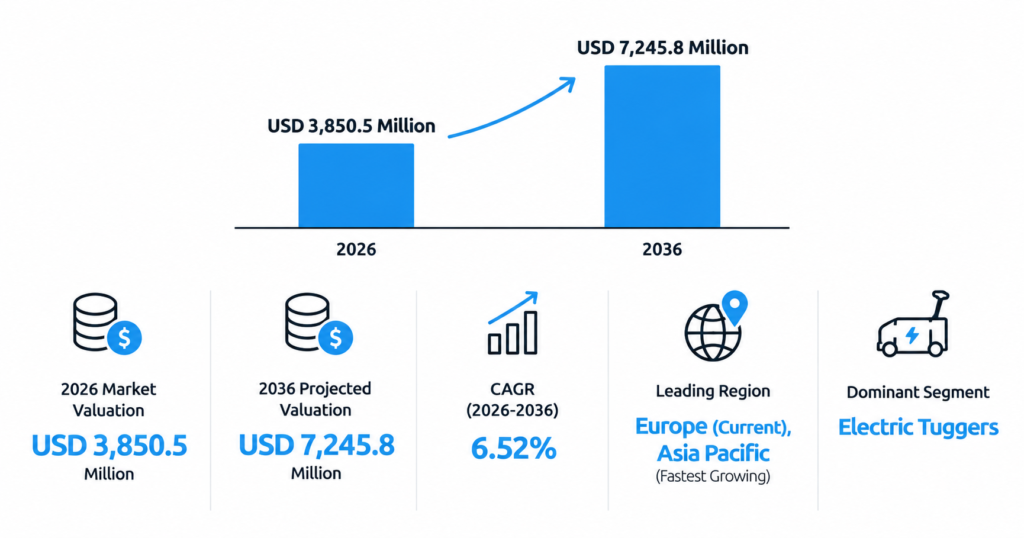
The global industrial tugger market size was valued at USD 3,850.5 million in 2026 and is anticipated to reach USD 7,245.8 million by 2036, expanding at a compound annual growth rate (CAGR) of 6.52% during the forecast period. This robust expansion is primarily attributed to the accelerating shift toward automated material handling solutions, the rapid growth of the global e-commerce sector, and the increasing implementation of lean manufacturing principles across diverse industrial landscapes. Industrial tuggers, also known as tow tractors or electric tugs, have become indispensable in modern logistics for their ability to move heavy loads efficiently and safely over short to medium distances.
The industrial tugger market is undergoing a transformative phase as global supply chains demand higher throughput and lower labor costs. The transition from manual material handling to mechanized and automated solutions is no longer a luxury but a necessity for competitive survival. Industrial tuggers offer a versatile alternative to traditional forklifts, especially in environments where space is constrained or where ‘fork-free’ safety initiatives are being implemented. The ability of a single tugger to pull multiple trailers in a ‘tugger train’ configuration significantly enhances logistics efficiency, reducing the number of trips required to move materials from receiving docks to production lines.
However, the market is not without its hurdles. The initial capital expenditure for high-capacity electric tuggers and the necessary charging infrastructure can be substantial for small and medium-sized enterprises. Furthermore, the integration of advanced software for fleet management and autonomous navigation requires a skilled workforce, which is currently in short supply in several regions. Despite these challenges, the long-term benefits of reduced workplace injuries, lower carbon footprints, and optimized workflow continue to drive adoption. The market is also seeing a surge in demand from non-traditional sectors such as healthcare and aviation, where tuggers are used for moving heavy medical equipment and ground support baggage carts, respectively.
The industrial tugger market is characterized by a mix of established global giants and specialized regional players. The competitive environment is increasingly focused on technological differentiation, particularly in the realms of battery efficiency and autonomous capabilities. Market concentration is moderate, with top-tier manufacturers holding significant shares in the high-capacity and specialized tugger segments, while numerous smaller firms compete in the light-duty and manual-assist categories. Strategic partnerships between hardware manufacturers and software developers are becoming common as the industry moves toward ‘Logistics 4.0’.
Demand is heavily influenced by the global manufacturing index and the health of the retail sector. As e-commerce giants expand their fulfillment center networks, the need for agile and reliable towing solutions grows. Regulatory frameworks regarding workplace safety, such as those established by OSHA in the United States and the European Agency for Safety and Health at Work, are also pivotal. These regulations often favor tuggers over forklifts for horizontal transport due to better visibility for operators and a lower risk of tip-over accidents. Additionally, the global push for sustainability is forcing a phase-out of internal combustion engine (ICE) tractors in favor of electric models, creating a massive replacement market.
The electric tugger segment accounted for the largest revenue share of approximately 72% in 2026. This dominance is expected to persist and even grow as battery technology improves. Electric tuggers are preferred for indoor applications due to their lack of exhaust emissions and quiet operation. They are highly efficient in pharmaceutical plants, food processing facilities, and high-tech manufacturing cleanrooms. The development of fast-charging and opportunity-charging lithium-ion batteries has addressed previous concerns regarding downtime, making electric models viable for multi-shift operations. Furthermore, the lower maintenance requirements of electric motors compared to internal combustion engines provide a compelling total cost of ownership (TCO) advantage over the vehicle’s lifespan.
Internal combustion (IC) tuggers, powered by diesel, LPG, or gasoline, still maintain a presence in heavy-duty outdoor applications. These are typically used in shipyards, construction sites, and for airport ground support where high torque and the ability to operate in extreme weather conditions are paramount. However, this segment is growing at a much slower pace compared to its electric counterparts. Innovations in IC engines focus on meeting Tier 4 and Stage V emission standards, but the overall trend is a gradual shift toward high-voltage electric systems even in these demanding environments. Hybrid models are also emerging as a bridge technology, though their market share remains niche.
The manufacturing sector led the market in 2026, representing over 40% of the total revenue. Within manufacturing, the automotive and aerospace industries are the primary drivers. These sectors utilize tuggers to move heavy sub-assemblies and components through complex production stages. The ‘just-in-time’ (JIT) and ‘just-in-sequence’ (JIS) delivery models rely heavily on the reliability of tugger trains to keep assembly lines moving without interruption. As automotive plants transition to electric vehicle (EV) production, the internal logistics are also being upgraded with modern, energy-efficient towing solutions.
The logistics and warehousing segment is projected to be the fastest-growing application area through 2036. The explosion of third-party logistics (3PL) providers and the need for rapid order fulfillment are driving the adoption of tuggers in large-scale distribution centers. Tuggers are increasingly used to transport goods from automated storage and retrieval systems (AS/RS) to packing stations. In the aviation sector, tuggers are essential for ground handling operations, including baggage towing and moving small aircraft. The healthcare sector is also emerging as a significant user, employing compact electric tuggers to move laundry carts, waste bins, and heavy imaging equipment through hospital corridors, thereby reducing the physical strain on staff.
Europe held the largest market share in 2026, accounting for nearly 35% of global revenue. This is due to the region’s early adoption of lean manufacturing and stringent labor safety laws. Countries like Germany, France, and Italy have a high density of automotive and machinery manufacturing plants that have long integrated tow tractors into their workflows. Furthermore, the European Green Deal is accelerating the transition to electric fleets across all industrial sectors. The presence of several leading manufacturers in the region also facilitates rapid technological adoption and robust after-sales support.
The Asia Pacific region is expected to grow at the fastest CAGR during the forecast period. China’s role as a global manufacturing hub, combined with India’s ‘Make in India’ initiative, is creating a massive demand for material handling equipment. The rapid urbanization and the growth of the middle class in these countries are driving the e-commerce sector, which in turn necessitates advanced warehousing solutions. Japan and South Korea remain key markets due to their advanced robotics industries and high levels of factory automation. Investments in new airport infrastructure across the region are also boosting the demand for ground support tuggers.
North America remains a significant market, driven by the modernization of aging warehouses and a strong focus on enhancing supply chain resilience. The United States is seeing a trend toward ‘reshoring’ manufacturing, which involves building new, highly automated facilities that utilize the latest tugger technologies. In Latin America and the Middle East, growth is linked to the expansion of the logistics sector and investments in diversifying economies away from oil and gas, particularly in countries like Saudi Arabia and the UAE, where new ‘smart cities’ and logistics hubs are being developed.
The following are the leading companies in the industrial tugger market. These organizations are at the forefront of innovation, safety, and global distribution.
In late 2025, several major players announced the integration of AI-driven predictive maintenance into their tugger fleets. This technology allows operators to anticipate component failures before they occur, significantly reducing unplanned downtime. Furthermore, the industry has seen a surge in ‘Tugger-as-a-Service’ (TaaS) business models, allowing companies to lease fleets with full maintenance packages, lowering the barrier to entry for smaller firms. In 2026, a leading European manufacturer launched a 50-ton capacity electric tugger specifically designed for the wind energy sector to move massive turbine components, showcasing the expanding load-bearing capabilities of electric drivetrains.
This report provides a comprehensive analysis of the industrial tugger market, segmenting it by product, load capacity, application, and geography to provide a granular view of the industry’s trajectory.
Product Outlook (Revenue, USD Million, 2026 – 2036)
Load Capacity Outlook (Revenue, USD Million, 2026 – 2036)
Application Outlook (Revenue, USD Million, 2026 – 2036)
Region Outlook (Revenue, USD Million, 2026 – 2036)
Get tailored market insights, segment analysis, regional data, and competitive intelligence aligned with your specific business requirements.