
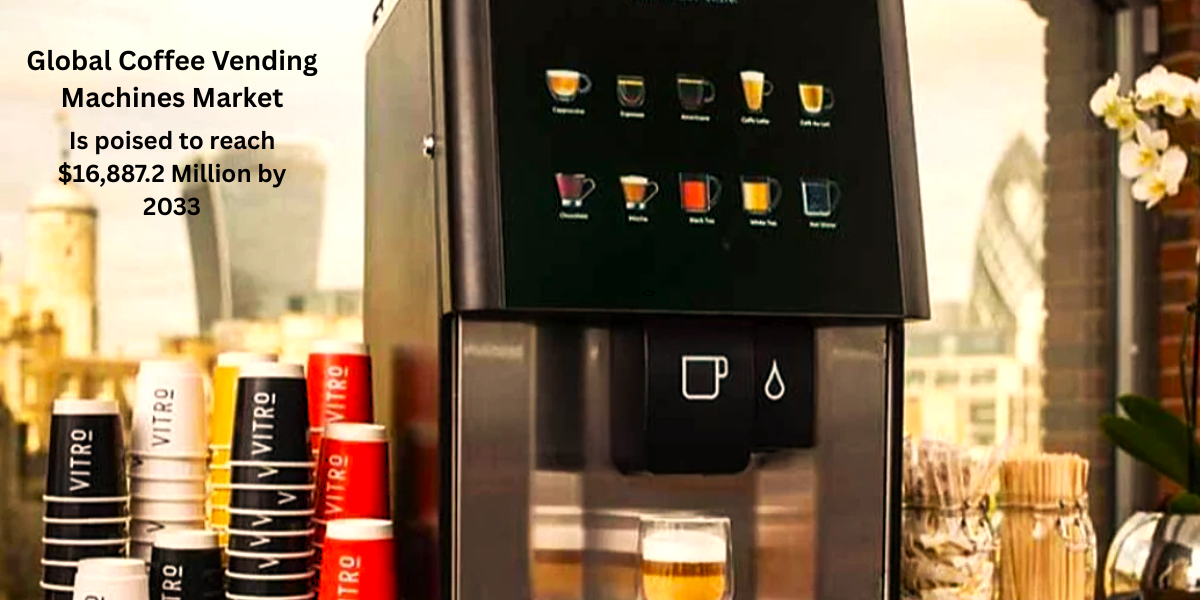
The global Coffee Vending Machines market was valued at $7,887.06 Million in 2021 and is expected to reach $10,165.5 Million by 2025. Market Research Port projects that by 2033, the market size will rise to $16,887.2 Million, growing at a CAGR of 6.55% from 2025 to 2033.
According to Market Research Port, the global Coffee Vending Machines market was $17,581.2 Million in 2024, with a forecasted CAGR of 8.00% from 2024 to 2031.
North America accounted for over 40% of global revenue with a market size of $7,032.48 Million in 2024, expected to grow at a CAGR of 6.2%.
Europe held a market share of more than 30%, valued at $5,734.36 Million in 2024.
Asia Pacific contributed approximately 23% of global revenue, with a market size of $4,043.68 Million in 2024 and a CAGR of 10.0%.
Latin America accounted for 5%, valued at $879.06 Million in 2024 (CAGR 7.4%).
Middle East & Africa held around 2%, with $351.62 Million in 2024 (CAGR 7.7%).
The Instant Vending Machine segment held the largest revenue share in 2024.
The global coffee vending machines market involves the production, distribution, and operation of self-service machines that serve coffee-based beverages. These machines provide convenience in offices, schools, airports, and public spaces, offering drinks such as coffee, cappuccino, latte, and hot chocolate. Key players include vending machine manufacturers, coffee suppliers, and operators.
The global coffee vending machines market’s growth is fueled by:
Rising demand for on-the-go beverages
Consumer preference for premium coffee experiences
Technological advances in vending machines
Urbanization, changing work habits, and higher disposable incomes
The coffee vending machines market is shaped by a combination of evolving consumer behavior, technological advances, and changing economic and social patterns. As societies become more urbanized and fast-paced, demand for quick and convenient beverage solutions rises. At the same time, innovations in vending technology — from payment systems to automation — enhance the appeal, reliability, and scalability of coffee vending. Regulatory and economic shifts, global health events, and competition from traditional retail formats also influence how the market evolves. Overall, the dynamics reflect a balance between opportunity (convenience, demand, tech) and challenge (competition, hygiene, cost), driving gradual but sustained growth across regions.
Modern life — especially in urban centers — often means long commutes, tight schedules, and limited time for traditional coffee shop visits. Coffee vending machines directly address this need by offering fast, instant access to coffee at offices, transit hubs, educational campuses, hospitals, and public spaces. Users can get a hot beverage with a simple button press — no waiting, no queue, no need to brew. This convenience is a major driver especially among professionals, students, and commuters who need a reliable caffeine fix without time overhead.
Over the past decade, consumers’ taste for coffee has become more sophisticated. Rather than just basic instant coffee, people now demand premium, specialty, and customizable drinks — lattes, cappuccinos, espresso, flavored coffees, even gourmet blends. Vending machines are adapting with better brewing mechanisms, bean-to-cup systems, and a wider beverage menu. This shift to premium coffee through vending platforms appeals to consumers who want quality quickly — and helps vending operators target a more discerning customer base.
Vending machines today are far more advanced than simple cup dispensers. Modern coffee vending machines integrate:
IoT connectivity for real-time inventory tracking
Automated brewing and grinding mechanisms
Multiple payment modes: cashless, mobile wallets, QR, NFC, cards
Self-cleaning or sanitation features
Customizable drink options and user interfaces
These innovations improve reliability, hygiene, user-friendliness, and operational efficiency. For operators, automation reduces labor costs and allows 24/7 operations; for consumers, it delivers convenience, speed, and variety.
Originally most popular in offices and factories, coffee vending machines are now found in airports, malls, hotels, hospitals, universities, co-working spaces, residential complexes, and other public venues. As infrastructure grows and demand diversifies, each new deployment setting represents incremental growth — helping expand overall market penetration globally.
While vending machines offer convenience, traditional coffee shops still hold strong appeal — offering not just beverages but an ambience, social experience, customized service, and a wider menu. Many customers enjoy the café atmosphere, barista-prepared drinks, and the ability to linger. Vending machines must constantly upgrade to match the variety and quality offered by cafés. For frequent café-goers valuing experience over speed, vending may not fully replace traditional shops — limiting growth potential in certain demographics.
Shared machines — especially ones dispensing hot beverages — may raise hygiene concerns among some users. Especially post-COVID, customers may worry about cleanliness of cup dispensers, contact surfaces, or the water/bean supply. If operators fail to maintain high standards of cleaning and upkeep, consumer trust may erode. This challenge may reduce usage in sensitive places (hospitals, high-end offices), or require additional costs for sanitation — affecting profitability.
High-end coffee vending machines — especially bean-to-cup or fully automated models — come with significant upfront costs. Maintenance, regular servicing, refill of beans, milk/cream/powder, cleaning, and troubleshooting add operational expenses. For small businesses or operators in low-margin markets, these costs may serve as a barrier to adoption. Also, inadequate infrastructure (power supply, space, reliable supply chains) in some regions may limit deployment.
Coffee vending machines rely on continuous supply of raw materials — beans, milk, powders, cups, packaging, cleaning supplies. Disruptions (e.g. supply shortage, logistic delays) can hamper reliability. Additionally, regulations around food safety, hygiene, and vending operations vary by region; compliance may increase costs or restrict placement. These factors can restrain market expansion, especially in developing regions.
North America is one of the most mature and developed markets. High disposable incomes, a strong café culture, advanced digital payment infrastructure, and widespread acceptance of automated retail support robust adoption. Coffee vending machines are popular in offices, universities, malls, transport hubs, and hotels. Demand for premium coffee and convenience, combined with readiness for cashless payments and IoT-enabled vending, makes this region a stable high-revenue market.
In Europe, growth is driven by urbanization, rising demand for sustainable and efficient vending solutions, and preference for specialty beverages. Many European countries also emphasize energy efficiency, eco-friendly operations, and hygiene standards — encouraging adoption of modern vending machines with updated features. Vending machines serve a variety of environments: offices, shopping centers, hospitals, transport hubs, and public venues — making this region important for long-term growth.
This region is currently one of the fastest-growing markets for coffee vending machines. Rapid urbanization, increasing working population, expanding commercial infrastructure, and rising disposable incomes fuel demand. In markets like Japan and South Korea — already accustomed to vending culture — adoption is high. Emerging markets such as India, China, Southeast Asia, and others are quickly catching up: growing demand for convenience, combined with acceptance of mobile and digital payments, creates fertile ground for vending. Future growth potential is very strong here.
Latin America shows steady growth, supported by increasing urban populations, expanding retail and commercial hubs, and growing interest in ready-to-drink coffee. Vending machines offer a cost-effective alternative to cafés — appealing especially in office buildings, malls, airports, and universities. Mixed payment behavior (cash and cashless) means operators often deploy hybrid machines to suit local preferences, helping overcome infrastructure and adoption challenges.
Although currently smaller in market share than other regions, these regions are showing promising growth. Expansion of hospitality, travel, and commercial sectors — especially in the Gulf, Gulf Cooperation Council (GCC) countries, South Africa, and other key markets — is driving demand for coffee vending machines in airports, hotels, business complexes, residential buildings, and corporate offices. As infrastructure improves and digital payments become more common, these regions could see significant growth in vending adoption.
By Type
Instant Vending Machine – Dominant segment, offering quick access to beverages in high-traffic areas.
Espresso Vending Machine – Fastest-growing segment, serving specialty espresso drinks efficiently.
Tea Coffee Vending Machine
Others
By Application
Offices – Dominant application segment, providing convenience for employees.
Restaurants – Fastest-growing, enhancing dine-in services with grab-and-go options.
Hospital, Public Transport Hubs, Shopping Mall, Others
By Type of Beverage
Pre-ground Coffee – Dominant, convenient for high-footfall locations.
Freeze-dried Granules – Fastest-growing, ensuring quick, consistent coffee.
In-cup Vending, Bean-to-cup, Capsule/Pod, Fresh Brew, Filter Coffee, Instant, Others
By End-User
Household – Dominant segment, providing home convenience.
Commercial – Fastest-growing segment, serving offices, airports, hotels efficiently.
By Operation
Semi-Automated – Dominant, combines user-friendly interface with automated brewing.
Fully Automated – Fastest-growing, offers complete automation from bean to cup.
By Installation
Floor Standing Coffee Vending Machine – Dominant, versatile for large spaces.
Tabletop Coffee Vending Machine – Fastest-growing, compact and ideal for small spaces.
The global coffee vending machines market includes a mix of traditional electronics manufacturers, vending machine specialists, and innovative startups. These companies compete by:
Product innovation: Better brewing tech, bean-to-cup machines, improved cooling/heating, customizable drinks
Automation & smart features: IoT, remote monitoring, predictive maintenance, digital payment integration, data analytics
Strategic partnerships: Collaborations with coffee suppliers, facility managers, corporate offices, hospitality chains, and public venues
Geographical reach & distribution: Expanding presence in emerging markets (Asia-Pacific, Latin America, Middle East) for broader coverage
Marketing & value proposition: Emphasizing convenience, quality, hygiene, and 24/7 availability
Because of this variety, the global coffee vending machines market is fragmented but dynamic. Established players provide reliability and scale; newer entrants focus on niche segments — e.g. premium coffee, low-cost solutions, or specialized deployment (e.g. in hospitals, airports). This competition fosters continuous innovation and benefits end-users with better, more diverse offerings.
Some of the key players operating in the global market are as follows:-
Lavazza
Bravilor Bonamat
Seaga
Dallmayr
Bianchi Vending Group
Frontier Coffee
NESCAFÉ
VENDONS COFFEE
FAS International
Tameside Vending
Jofemar
Crane Merchandising Systems
EVOCA
Nuova Simonelli
Azkoyen Group
Rheavendors Group
Jetinno
Selecta
Coffetek
| Report Attributes | Details |
| Base Year | 2024 |
| Historical Data Time Period | 2021-2024 |
| Forecast Period | 2025-2033 |
| Market Split by Type | Instant, Espresso, Tea Coffee, Others |
| Market Split by Application | Office, Restaurant, Hospital, Transport, Mall, Others |
| Market Split by Beverage Type | Pre-ground, Freeze-dried Granules, In-cup, Bean-to-cup, Capsule/Pod, Fresh Brew, Filter Coffee, Instant |
| Market Split by End Use | Household, Commercial |
| Market Split by Operation | Semi-Automated, Fully Automated |
| Market Split by Installation | Floor Standing, Tabletop |
| List of Companies | Lavazza, Bravilor Bonamat, Seaga, Dallmay, Jetinno, Selecta |
| Regional Analysis | North America, Europe, APAC, Latin America, Middle East, Africa |
| Region Revenue | 2021 | 2023 | 2025 | CAGR |
| Global | $7,887.06M | $10,165.5M | $16,887.2M | 6.55% |
| North America | $2,366.12M | $2,997.95M | $4,812.84M | 6.10% |
| United States | $1,833.74M | $2,299.18M | $3,614.45M | 5.82% |
| Canada | $380.95M | $510.07M | $914.44M | 7.57% |
| Europe | $2,492.31M | $3,229.16M | $5,420.78M | 6.69% |
| UK | $319.02M | $401.14M | $634.23M | 5.89% |
| Germany | $471.05M | $605.97M | $1,002.84M | 6.50% |
| France | $366.37M | $477.89M | $813.12M | 6.87% |
| Italy | $269.17M | $356.13M | $623.39M | 7.25% |
| Rest of Europe | $107.17M | $132.98M | $194.61M | 4.88% |
| Asia Pacific | $1,940.22M | $2,505.79M | $4,179.57M | 6.60% |
| Japan | $370.58M | $466.61M | $739.79M | 5.93% |
| South Korea | $201.78M | $256.36M | $413.78M | 6.17% |
| Australia | $168.80M | $221.30M | $380.34M | 7.00% |
| Singapore | $113.31M | $149.21M | $258.72M | 7.12% |
| Taiwan | $60.15M | $75.53M | $119.12M | 5.86% |
| Latin America | $520.55M | $692.26M | $1,224.32M | 7.39% |
| Rest of South America | $8.85M | $9.70M | $12.86M | 3.58% |
| Middle East | $268.16M | $358.68M | $641.71M | 7.54% |
| Africa | $299.71M | $381.67M | $607.94M | 5.99% |
| Brazil | $222.79M | $295.13M | $517.89M | 7.28% |
What will be the market size of the Coffee Vending Machines Market by 2033?
The global Coffee Vending Machines market will reach $16,887.2 Million in 2033, reflecting the rising global demand for convenient, high-quality coffee solutions.
What is the expected growth rate of the Coffee Vending Machines market?
The global Coffee Vending Machines market is projected to expand at a strong CAGR of 8.00%, indicating steady demand and an increasing adoption across workplaces, public venues, and commercial spaces.
Which region currently leads the Coffee Vending Machines market?
North America dominated the global market in 2025, supported by advanced technology adoption, strong workplace culture, and a high preference for premium coffee.
Which region will experience the fastest growth in the upcoming years?
Europe is expected to record the fastest growth, driven by an expanding commercial infrastructure, rising coffee consumption, and increasing demand for automated beverage solutions.
Which region is expected to lead the global Coffee Vending Machines market by 2026?
The United States is set to remain the leading region in the Coffee Vending Machines market by 2026, backed by widespread deployment in offices, airports, universities, and retail environments.
What are the key factors driving the global market’s growth?
The global Coffee Vending Machines market growth is fueled by rising demand for premium and specialty coffee, fast-paced lifestyles that encourage on-the-go consumption and an increasing adoption of vending solutions driven by workplace culture and convenience.
Which type of coffee vending machine holds the largest market share?
The Instant Vending Machine segment remains the largest segment by market share, thanks to its affordability, speed, and adaptability across high-traffic locations.