
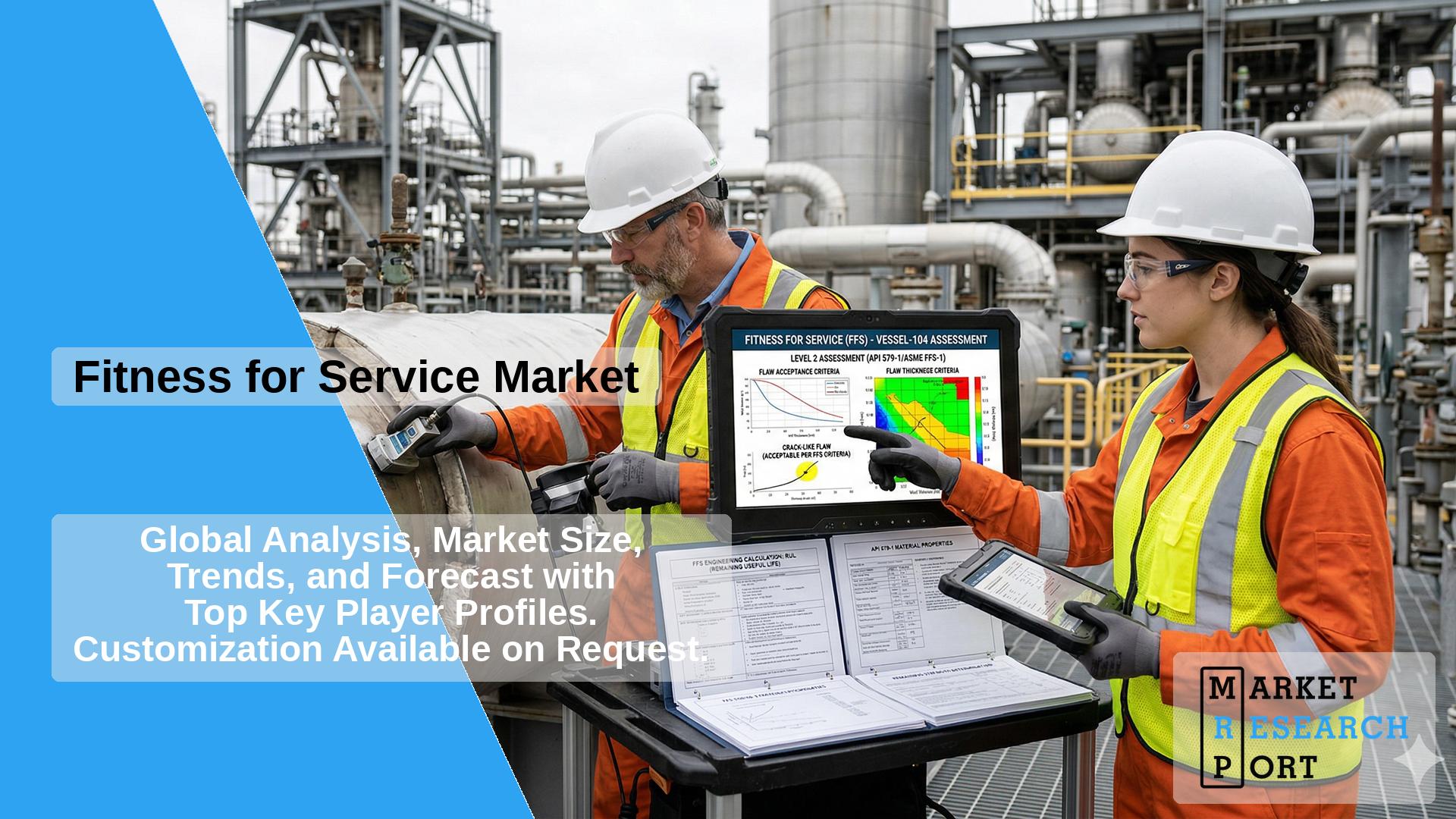
The global fitness for service market is undergoing a significant transformation as industrial sectors prioritize asset longevity and operational safety over traditional replacement cycles. The global fitness for service market size was valued at approximately USD 5.2 billion in 2026 and is projected to reach USD 10.8 billion by 2036, growing at a compound annual growth rate (CAGR) of 7.5% from 2026 to 2036. This growth is primarily driven by the aging of critical infrastructure in developed economies, stringent safety mandates established by regulatory bodies, and the economic necessity of extending the life of high-value assets such as pressure vessels, piping systems, and storage tanks.
Fitness for Service (FFS) assessments are quantitative engineering evaluations performed to demonstrate the structural integrity of an in-service component that may contain a flaw or damage. These assessments provide a clear ‘go/no-go’ decision regarding the continued operation of equipment. As global industrial players face increasing pressure to reduce capital expenditure, the ability to safely extend the operational life of a refinery or power plant becomes a competitive advantage. The shift from reactive maintenance to proactive asset integrity management is a cornerstone of this market’s expansion.
However, the market is not without its challenges. The high cost associated with advanced Level 3 assessments, which require specialized Finite Element Analysis (FEA) and highly skilled engineering personnel, can be a barrier for smaller operators. Furthermore, the accuracy of an FFS assessment is heavily dependent on the quality of data provided by Non-Destructive Testing (NDT) methods. Inconsistent data or poor inspection techniques can lead to overly conservative results, resulting in unnecessary shutdowns, or worse, unconservative results that risk catastrophic failure.
The fitness for service market is characterized by a mix of large global inspection and certification giants and specialized engineering consultancies. The market is moderately concentrated, with top-tier players leveraging their global footprint and multi-disciplinary expertise to secure long-term service agreements with major energy and chemical firms. These leaders often provide a ‘one-stop-shop’ solution, combining NDT inspections with engineering analysis. Smaller, niche players often compete by offering highly specialized expertise in specific degradation mechanisms, such as high-temperature hydrogen attack (HTHA) or complex fracture mechanics.
Innovation in this sector is currently focused on software automation and remote monitoring. The development of proprietary FFS software that aligns with the latest updates of API 579-1/ASME FFS-1 allows for faster turnaround times on assessments. Additionally, the market is seeing a trend toward ‘Continuous Fitness for Service,’ where sensors provide real-time data to an engineering model, allowing for dynamic updates to the asset’s remaining life based on actual operating conditions rather than theoretical design parameters.
The backbone of the FFS market is the API 579-1/ASME FFS-1 standard. This comprehensive document provides a consensus-based approach for evaluating various types of damage. The standard is divided into multiple parts, each addressing a specific type of flaw. These include general metal loss, localized metal loss, pitting corrosion, hydrogen blisters, weld misalignment, shell out-of-roundness, crack-like flaws, creep damage, and fire damage. The rigorous nature of these standards ensures that assessments performed by different engineering firms yield consistent and reliable results, which is critical for regulatory compliance and insurance purposes.
Beyond the API/ASME standards, other regional and industry-specific frameworks exist, such as BS 7910 in the United Kingdom and various R5/R6 procedures for the nuclear industry. The harmonization of these standards is a key trend, as multinational corporations seek to apply uniform asset integrity practices across their global operations. The ability of service providers to navigate these complex regulatory landscapes is a significant factor in their market competitiveness.
The metal loss segment, encompassing both general and localized corrosion, accounted for the largest share of FFS assessments in 2026. Corrosion remains the most prevalent threat to industrial assets, particularly in harsh environments such as offshore platforms and chemical plants. FFS assessments for metal loss involve calculating the remaining strength of the component based on the measured wall thickness and comparing it to the required thickness for the operating pressure. This allows operators to determine if a component can continue to operate at its current rating, needs to be derated, or requires immediate repair.
Crack-like flaws represent the most technically demanding and high-risk segment of the market. These flaws require advanced fracture mechanics evaluations to determine the stress intensity factor and compare it to the material’s fracture toughness. As assets age, the likelihood of fatigue cracking or environmental stress cracking increases, driving the demand for specialized Level 3 assessments. The growth in this segment is also fueled by the increasing use of high-strength alloys in modern industrial designs, which can be more susceptible to brittle fracture under certain conditions.
Level 1 assessments are the most basic and are typically performed by plant inspectors using screening criteria and simple tables provided in the standards. While they account for a high volume of assessments, their revenue share is lower due to their simplicity. Level 1 is intended to provide a quick conservative evaluation to see if a flaw is clearly acceptable without further detailed analysis.
Level 2 assessments represent the ‘sweet spot’ of the market. These are performed by engineers and involve more detailed calculations, often using specialized software. Level 2 assessments can account for more complex loading conditions and geometry than Level 1, often allowing for the justification of continued operation where a Level 1 assessment might have failed. This level is widely used for evaluating corrosion, pitting, and simple crack geometries.
Level 3 assessments are the most advanced and are reserved for complex geometries, high-consequence assets, or flaws that fail Level 2 criteria. These assessments often involve non-linear Finite Element Analysis (FEA), experimental testing, or specialized fracture mechanics. While the volume of Level 3 assessments is lower, they command the highest margins due to the level of expertise required. The demand for Level 3 services is growing as operators seek to squeeze every possible year of life out of their most critical and expensive assets.
Pressure vessels and heat exchangers constitute a major portion of the FFS market. These components are subject to high pressures, temperatures, and corrosive media, making them prone to various damage mechanisms. FFS assessments are critical during scheduled turnarounds to evaluate the impact of any damage found during inspection and to determine the interval for the next inspection. The ability to avoid a vessel replacement through a successful FFS assessment can save an operator millions of dollars in capital costs and lost production time.
Piping systems also represent a significant segment. Unlike pressure vessels, piping systems are often vast and complex, with thousands of individual components such as elbows, tees, and valves. FFS for piping often focuses on flow-accelerated corrosion (FAC), vibration-induced fatigue, and thermal expansion issues. The use of automated ultrasonic testing (AUT) and long-range ultrasonic testing (LRUT) provides the data necessary for these assessments, allowing for the evaluation of long stretches of piping with minimal insulation removal.
The oil and gas industry is the primary driver of the fitness for service market. From upstream offshore platforms to downstream refineries, the industry relies on FFS to manage the risks associated with aging assets and high-pressure operations. In the downstream sector, FFS is essential for managing damage mechanisms like high-temperature hydrogen attack (HTHA) and sulfidation corrosion. The shift toward processing heavier, high-sulfur crude oils has increased the corrosivity of the process environment, further driving the need for frequent and detailed FFS evaluations.
The power generation industry, including both fossil fuel and nuclear plants, is another major consumer of FFS services. In fossil fuel plants, FFS is primarily used to evaluate creep and fatigue damage in high-temperature boiler components and steam piping. In the nuclear sector, FFS is a critical component of license renewal applications, demonstrating that the reactor pressure vessel and other safety-related components can continue to operate safely beyond their original design life. The growing focus on carbon capture and storage (CCS) and hydrogen power is also expected to create new opportunities for FFS as these industries deal with unique material compatibility and high-pressure challenges.
North America dominated the global fitness for service market in 2026, with a revenue share of approximately 35%. This dominance is rooted in the region’s mature industrial base, particularly in the United States and Canada. The presence of major oil and gas companies, a stringent regulatory environment overseen by OSHA and the EPA, and the widespread adoption of API standards contribute to the high demand for FFS services. The U.S. Gulf Coast, with its high concentration of refineries and petrochemical plants, remains a key hub for FFS activity.
Europe is another significant market, driven by the need to maintain aging infrastructure and comply with the Pressure Equipment Directive (PED). Countries like Germany, the UK, and France have robust engineering sectors that are leaders in developing advanced FFS methodologies. The European market is also seeing a strong push toward integrating FFS with sustainability goals, as extending asset life reduces the environmental footprint associated with manufacturing new equipment.
The Asia Pacific region is expected to be the fastest-growing market between 2026 and 2036. Rapid industrialization in China and India, combined with the construction of massive new refining and petrochemical complexes, is creating a huge inventory of assets that will eventually require FFS assessments. Furthermore, as these countries modernize their safety regulations, the adoption of international FFS standards is increasing. The region’s focus on infrastructure development and energy security is providing a strong tailwind for the asset integrity management sector.
The following are the leading companies in the fitness for service market. These organizations provide a range of services from NDT inspection to advanced engineering analysis.
An FFS assessment is a multi-disciplinary engineering evaluation used to determine if an industrial component, such as a pipe or pressure vessel, is safe to continue operating despite having identified damage or flaws. It uses quantitative data to decide if the equipment can run as-is, needs a reduction in pressure/temperature, or requires repair.
The most widely recognized standard globally is API 579-1/ASME FFS-1. Other important standards include BS 7910 in the UK, FITNET in Europe, and various R-series codes used in the nuclear power industry.
Level 1 is a simple screening performed by inspectors using basic tables. Level 2 is a more detailed engineering calculation performed by qualified engineers. Level 3 is the most advanced, involving complex computer modeling (like Finite Element Analysis) for unique or high-risk situations where Level 2 results are insufficient.
Growth is driven by the aging of global industrial infrastructure, stricter safety and environmental regulations, and the economic benefit of extending the life of existing assets rather than spending capital on new replacements.
FFS provides a scientific, data-driven basis for operational decisions. By accurately predicting when a component might fail, it allows operators to perform maintenance or repairs before a catastrophic failure occurs, protecting workers and the environment.
The oil and gas industry is the largest user, followed by chemical processing, power generation (including nuclear), pulp and paper, and mining. Any industry with high-pressure or high-temperature equipment relies on FFS.
AI and Digital Twins allow for more accurate and predictive assessments. They can process vast amounts of historical inspection data to identify patterns of degradation and create a virtual model of the asset that updates in real-time based on actual operating conditions.
It saves money by preventing unnecessary shutdowns, avoiding the cost of premature equipment replacement, and optimizing maintenance schedules. A successful assessment can justify keeping a multi-million dollar vessel in service for several more years.
The most common damage types are metal loss (corrosion), pitting, crack-like flaws (fatigue or stress corrosion cracking), and mechanical damage like dents, gouges, or weld misalignments.
While the standards themselves are often voluntary, many regulatory bodies (like OSHA in the US) require that equipment be maintained in a safe operating condition. FFS is the industry-accepted method for demonstrating that ‘in-service’ equipment meets these safety requirements, making it a de facto legal necessity for compliance.