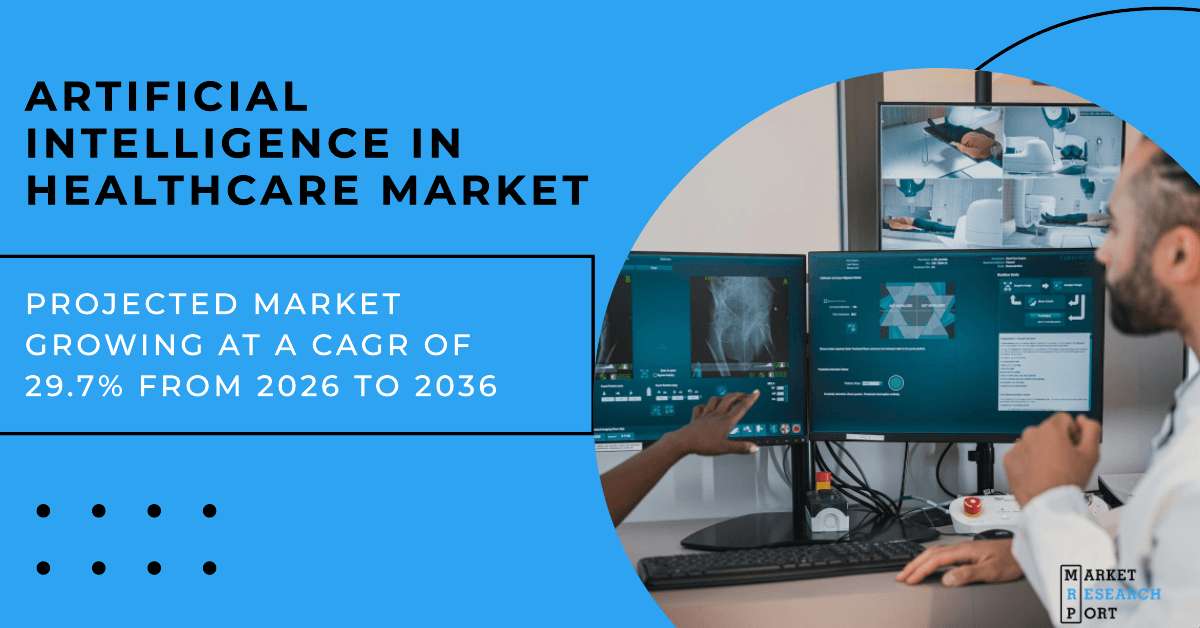
The global artificial intelligence in healthcare market size is estimated to be valued at USD 45.2 billion in 2026 and is projected to reach USD 610.5 billion by 2036, growing at a Compound Annual Growth Rate (CAGR) of 29.7% from 2026 to 2036. The integration of artificial intelligence (AI) into the healthcare sector represents one of the most transformative shifts in modern medicine. By leveraging complex algorithms, machine learning, and advanced computing power, healthcare providers are now able to analyze vast amounts of medical data with unprecedented speed and accuracy. This evolution is not merely about automation; it is fundamentally about augmenting human intelligence to improve patient outcomes, significantly reduce operational costs, and rapidly accelerate the discovery of life-saving treatments. As the industry progresses toward the next decade, the synergy between data science and clinical practice is expected to redefine the boundaries of what is possible in diagnostics, surgery, and highly personalized care.
North America held a significant market share in 2026, supported by the early adoption of digital health records, the presence of major technology giants, and robust private and public funding for medical infrastructure.
The Asia Pacific region is anticipated to be the fastest-growing market due to massive investments in digital health modernization, aging populations, and the proliferation of health data in emerging economies.
By technology, deep learning and machine learning remain the most heavily invested segments, acting as the computational backbone for most clinical AI applications.
By application, medical imaging and diagnostics are currently dominating, driven by the immediate clinical return on investment and high accuracy rates of AI in radiology and pathology.
2026 Estimated Market Size: USD 45.2 Billion
2036 Projected Market Size: USD 610.5 Billion
CAGR (2026-2036): 29.7%
Leading Region: North America
Fastest Growing Region: Asia Pacific
The evolution of clinical environments into interconnected, data-rich ecosystems has placed artificial intelligence at the forefront of modern healthcare infrastructure. These AI systems do much more than process billing codes; they serve as a dynamic backbone for predictive analytics and preventative medicine. Primarily, the explosion of digital health data—comprising electronic health records (EHRs), high-resolution medical imaging, genomic sequencing data, and continuous feeds from wearable biosensors—provides the essential raw material necessary for training sophisticated AI models. Furthermore, the global shortage of healthcare professionals, projected by the WHO to reach critical levels in the coming decade, has created a pressing need for automated tools that can assist in triage and routine diagnostic tasks. AI-driven solutions offer a critical pathway to alleviate the administrative and cognitive burden on clinicians, allowing them to redirect their focus toward high-value, empathetic patient interactions. Additionally, the rising global prevalence of chronic diseases, notably cancer, cardiovascular conditions, and diabetes, necessitates more efficient, continuous monitoring and early detection systems—areas where AI excels by identifying subtle patterns long before symptoms manifest.
Despite the highly optimistic growth trajectory, the market faces significant hurdles related to systemic complexity and regulatory bottlenecks. Data privacy and security remain paramount concerns, as medical information is among the most sensitive personal data in existence. Ensuring strict compliance with complex regulatory frameworks such as the General Data Protection Regulation (GDPR) in Europe and the Health Insurance Portability and Accountability Act (HIPAA) in the United States, while simultaneously maintaining the massive, unimpeded flow of data required for AI training, is a delicate and expensive balance. Moreover, the ‘black box’ nature of complex deep learning algorithms—where the system’s decision-making process is not easily interpretable by human users—can lead to skepticism among medical practitioners who rightfully demand transparency and explainability in clinical decision-making. High initial implementation costs, the requirement for robust cybersecurity infrastructure, and the chronic lack of interoperability between disparate legacy healthcare IT systems also pose substantial hurdles to widespread, seamless adoption across smaller hospitals and rural clinics.
Opportunities in the market are abundant, particularly with the rollout of Generative AI, large language models (LLMs) tuned for medical data, and the rise of decentralized clinical trials. AI is increasingly being viewed as the ideal connective tissue between disparate healthcare silos. The concept of “Ambient Clinical Intelligence” is gaining rapid momentum, where AI continuously operates in the background of a patient visit, securely transcribing, analyzing, and structuring the conversation directly into the EHR without the physician touching a keyboard. This multi-functionality allows clinical environments to maximize the value of their time. Moreover, the emergence of “AI-as-a-Service” (AIaaS) business models in healthcare is helping underfunded clinics overcome budget constraints. By allowing them to pay for AI diagnostic insights on a per-scan or subscription basis rather than investing heavily in proprietary supercomputing hardware, the financial burden shifts, encouraging wider adoption across tiered healthcare systems globally.
The global artificial intelligence in healthcare market is characterized by a moderate to high level of concentration at the foundational platform level, combined with intense fragmentation at the application level. Technology titans such as Alphabet (Google Health), Microsoft, IBM, and NVIDIA hold significant market shares in providing the underlying cloud computing infrastructure, AI accelerators, and foundational machine learning frameworks. These industry leaders focus on providing end-to-end, scalable environments and forging massive strategic partnerships with national health systems and premier research hospitals. Conversely, a growing, highly dynamic ecosystem of specialized technology firms and agile startups—such as PathAI, Aidoc, and Freenome—are aggressively entering the market, offering niche, highly accurate solutions for specific medical disciplines like digital pathology, genomic liquid biopsies, and acute stroke detection. This intensely competitive environment fosters rapid innovation, particularly in the development of edge AI computing (processing data directly on medical devices like ultrasound wands) and advanced multimodal data analytics.
Innovation is the primary driver of market dynamics. Developers are focusing heavily on multimodal AI models that can simultaneously ingest and synthesize text (clinical notes), images (MRIs), and structured data (lab results) to provide a holistic patient risk profile. There is also a significant trend toward federated learning—a decentralized machine learning approach where the algorithm is sent to the hospital’s local servers to learn from the data, rather than sending sensitive patient data to a centralized cloud. This breakthrough elegantly addresses data privacy concerns while still improving the global AI model. Ethical sustainability and algorithmic fairness are other key characteristics defining modern market leaders, with companies actively auditing their models to reduce inherent biases related to race, gender, or socioeconomic status that may skew diagnostic accuracy. The market is also seeing a vital shift toward rigorous, peer-reviewed clinical validation to secure critical approvals from regulatory bodies like the FDA, transforming AI from a theoretical computer science experiment into a certified Medical Device (SaMD).
Machine learning remains the undisputed backbone of AI in healthcare, capturing the largest revenue share in the technology segment. Within this broad category, deep learning—utilizing artificial neural networks with multiple layers—is particularly influential due to its unmatched ability to process massive, unstructured datasets. Deep learning models are currently being deployed to identify microscopic patterns in radiological images and histopathology slides that are fundamentally invisible to the human eye, leading to significantly earlier diagnoses of aggressive conditions like breast cancer, lung nodules, and neurodegenerative disorders. The inherent ability of these systems to learn iteratively and improve their predictive accuracy over time as they are exposed to more clinical data makes them an invaluable, continuously appreciating asset in a clinical setting.
NLP technology is revolutionizing the traditionally burdensome way healthcare documentation and semantic data are handled. By intelligently converting unstructured clinical notes, physician dictations, and raw medical literature into structured, analyzable data, NLP allows for vastly improved data mining, cohort selection for clinical trials, and population health research. It also powers the next generation of intelligent virtual assistants, triage bots, and ambient listening devices. These tools can interact contextually with patients, answer routine medical queries accurately, schedule optimized appointments, and automatically generate medical billing codes, thereby drastically enhancing patient engagement while saving countless administrative hours.
Computer vision is a critical growth segment, fundamentally reshaping medical imaging and the burgeoning field of robot-assisted surgery. In diagnostic imaging, computer vision algorithms assist in the rapid, automated detection, segmentation, and quantification of anomalies in X-rays, MRIs, CT scans, and retinal sweeps. It acts as an tireless second set of eyes, flagging urgent cases—such as intracranial hemorrhages or pneumothorax—and bumping them to the top of the radiologist’s worklist. In the operating room, advanced computer vision integrated with surgical robots provides surgeons with real-time, augmented reality feedback, enhanced structural visualization, and spatial tracking, which dramatically improves the precision and safety of complex, minimally invasive procedures.
This segment represents one of the most mature, heavily adopted, and commercially successful applications of AI in healthcare today. AI algorithms are deeply embedded in the workflows of various specialties, including oncology, cardiology, neurology, and ophthalmology. By standardizing image analysis and providing quantitative assessments, AI reduces the historically high rates of inter-observer variability, false negatives, and false positives. It ensures that patients receive timely, accurate diagnoses regardless of the specific clinic they visit. The volume of medical imaging is growing exponentially faster than the number of trained radiologists, solidifying AI’s role not just as an enhancement, but as an operational necessity to manage the backlog of critical scans.
The traditional drug discovery and clinical trial process is notoriously lengthy, spanning over a decade, and prohibitively expensive, often costing billions of dollars per approved drug. AI is drastically shortening this timeline and changing the pharmaceutical economic model. Algorithms can now predict the 3D folding structures of proteins, model how millions of different synthetic chemical compounds will interact with specific biological disease targets, and simulate toxicological side effects before a single compound is synthesized in a lab. This enables pharmaceutical companies to identify highly promising drug candidates much earlier in the pipeline, reducing the staggering costs of R&D failure, rescuing previously failed drugs through repurposing, and bringing novel therapies to market years faster.
AI-powered virtual assistants, conversational agents, and digital therapeutics are becoming ubiquitous in patient-facing applications. These proactive tools are critical for the shift toward preventative, value-based care. They help patients actively manage chronic conditions like diabetes or hypertension, send intelligent reminders for medication adherence based on behavioral patterns, and provide personalized health advice leveraging continuous real-time data from wearable IoT devices like smartwatches and glucose monitors. By maintaining continuous engagement outside the four walls of the hospital, these AI tools reduce hospital readmission rates and empower patients to take ownership of their health trajectories.
North America
North America led the global market in 2026, driven by a uniquely high concentration of premier academic medical centers, aggressive smart hospital initiatives, and a heavily funded technology sector in the United States and Canada. The region benefits from a mature, digitized healthcare ecosystem resulting from the HITECH Act’s push for EHR adoption, creating the massive datasets AI requires. Federal agencies, notably the FDA, have established clear, albeit rigorous, regulatory pathways for AI/ML-based software, leading to hundreds of commercial approvals. The presence of leading AI hyperscalers and a robust venture capital environment for biotech startups ensures that the region remains the global hub for medical AI innovation and early-stage deployment.
Europe
Europe follows as a highly significant market, defined by strong, centralized government support for digital health initiatives balanced with the world’s most stringent data protection frameworks. The European Union’s focus on creating the “European Health Data Space” aims to facilitate secure cross-border data sharing for AI research. Countries like the UK (through the NHS AI Lab), Germany, and France are investing heavily in AI to modernize their nationalized health systems, aiming to reduce wait times and improve care equity. The overarching theme in Europe is “Trustworthy AI,” with an intense focus on algorithmic transparency, ethical AI deployment, and ensuring that technological advancement strictly adheres to patient privacy rights under GDPR.
Asia-Pacific
The Asia-Pacific region is unequivocally expected to witness the highest growth rate during the forecast period from 2026 to 2036. Rapid, large-scale urbanization, massive population bases, and a rapidly aging demographic in powerhouses like Japan and China are creating an unprecedented demand for healthcare automation. The Chinese government’s strategic mandate to lead globally in AI by 2030 has resulted in massive state-backed investments in medical computer vision and genomics. In India, ambitious national digital health missions aim to leapfrog traditional infrastructure barriers, utilizing mobile-first, AI-driven diagnostic tools to deliver expert-level care to remote, underserved rural populations. The region’s growth is fundamentally supported by a willingness to rapidly adopt new technologies and an increasing per-capita healthcare expenditure.
Latin America and Middle East & Africa (MEA)
Latin America and the MEA regions are vital emerging markets with massive, untapped potential. In Latin America, health systems in Brazil and Mexico are increasingly utilizing AI for population health analytics and to power sophisticated telemedicine platforms that bridge the gap between urban specialists and rural patients. In the MEA region, particularly within the Gulf Cooperation Council (GCC), countries like Saudi Arabia and the UAE are integrating cutting-edge AI into healthcare as a core pillar of their national economic diversification strategies. Mega-projects and newly built smart cities in these regions are unburdened by legacy IT systems, allowing them to implement state-of-the-art, AI-native hospital infrastructure from the ground up.
The following companies are the primary drivers of innovation, strategic partnerships, and market growth in the artificial intelligence in healthcare sector:
IBM Watson Health
Google Health (Alphabet Inc.)
Microsoft Corporation
NVIDIA Corporation
Intel Corporation
General Electric (GE Healthcare)
Siemens Healthineers
Medtronic
Amazon Web Services (AWS)
Oracle (Cerner)
Philips Healthcare
Johnson & Johnson
Tencent Holdings Ltd.
Baidu, Inc.
Alibaba Cloud
Butterfly Network, Inc.
Babylon Health
Enlitic, Inc.
PathAI
Zebra Medical Vision (Nanox)
Aidoc
Tempus
Insilico Medicine
Atomwise, Inc.
BenevolentAI
Recursion Pharmaceuticals
CloudMedx, Inc.
Welltok, Inc.
Precision Health AI
Olive
Viz.ai
Freenome
Grail
HeartFlow, Inc.
Caption Health
In late 2024, Google Health announced a major expansion of its medical LLM (Large Language Model) capabilities, integrating it directly into several major hospital EHR systems. This integration demonstrated a 40% reduction in physician documentation time and significantly improved the automated extraction of actionable insights from unstructured patient histories.
In early 2025, NVIDIA launched a specialized, medical-grade edge computing platform designed specifically for surgical robotics and real-time medical imaging, allowing complex deep learning models to run directly in the operating room with near-zero latency without requiring a continuous cloud connection.
In mid-2025, PathAI partnered with a global pharmaceutical consortium to deploy its advanced digital pathology AI globally, standardizing tissue scoring for oncology clinical trials. This initiative successfully accelerated patient cohort selection for novel immunotherapy drugs by over six months.
In late 2025, Microsoft Corporation (via its Nuance division) introduced a groundbreaking, fully ambient clinical intelligence tool for emergency departments. The AI autonomously triages incoming patients based on visual, auditory, and historical data, assigning acuity scores that have been shown to reduce emergency room wait times in pilot hospitals by 25%.
| Report Attribute | Details |
| Market size value in 2026 | USD 45.2 billion |
| Revenue forecast in 2036 | USD 610.5 billion |
| Growth rate | CAGR of 29.7% from 2026 to 2036 |
| Base year for estimation | 2025 |
| Historical data | 2020 – 2024 |
| Forecast period | 2026 – 2036 |
| Quantitative units | Revenue in USD billion and CAGR from 2026 to 2036 |
| Report coverage | Revenue forecast, company ranking, competitive landscape, growth factors, and trends |
| Segments covered | Technology/Component, Application, Region |
| Regional scope | North America; Europe; Asia Pacific; Latin America; Middle East & Africa |
| Country scope | U.S.; Canada; UK; Germany; France; China; India; Japan; Brazil; Saudi Arabia; UAE |
| Key companies profiled | Google Health, Microsoft, IBM, NVIDIA, GE Healthcare, Siemens Healthineers, Philips Healthcare, PathAI, Aidoc, Tempus |
This report forecasts revenue growth at global, regional, and country levels and provides an analysis of the latest industry trends in each of the sub-segments from 2026 to 2036.
Software
Machine Learning & Deep Learning Platforms
Natural Language Processing (NLP) Engines
Context-Aware Computing & Computer Vision
Hardware
AI-specific Processors (GPUs, TPUs)
Edge Computing Nodes
Network Infrastructure
Services
Deployment & Integration Services
Support & Maintenance
AI Consulting & Training
Clinical Applications
Medical Imaging & Diagnostics
Robot-Assisted Surgery
Precision Medicine & Genomics
Research & Development
Drug Discovery & Development
Clinical Trial Patient Matching
Administrative & Patient Facing
Virtual Assistants & Chatbots
Workflow & Administrative Automation
Wearables & Remote Patient Monitoring
North America
U.S.
Canada
Europe
Germany
UK
France
Italy
Spain
Asia Pacific
China
India
Japan
South Korea
Australia
Latin America
Brazil
Mexico
Argentina
Middle East & Africa
Saudi Arabia
UAE
South Africa
The market is projected to reach approximately USD 610.5 Billion by 2036, growing at a CAGR of 29.7% from 2026.
AI uses computer vision and deep learning to analyze X-rays, MRIs, and CT scans, helping doctors detect diseases like cancer or fractures more accurately and quickly.
Yes, AI reduces costs by automating administrative tasks, improving diagnostic accuracy to avoid unnecessary treatments, and accelerating the drug discovery process.
Key challenges include data privacy concerns, the high cost of implementation, the need for specialized training for staff, and the difficulty of integrating AI with existing legacy systems.
The Asia-Pacific region is expected to exhibit the fastest growth due to increasing healthcare investments and a large patient population.
AI analyzes biological data to predict how new drugs will behave, which significantly speeds up the identification of effective treatments and reduces the failure rate in clinical trials.
No, AI is designed to be a tool that augments the capabilities of healthcare professionals, providing them with better data and insights to make more informed clinical decisions.
Through virtual assistants and wearable device integration, AI provides patients with personalized health monitoring, medication reminders, and 24/7 access to health information.
NLP is a technology that allows computers to understand and interpret human language, used in healthcare to organize clinical notes and extract useful data from patient records.
Ethical considerations include ensuring algorithmic transparency, preventing bias in AI models, and maintaining strict patient confidentiality and data security.