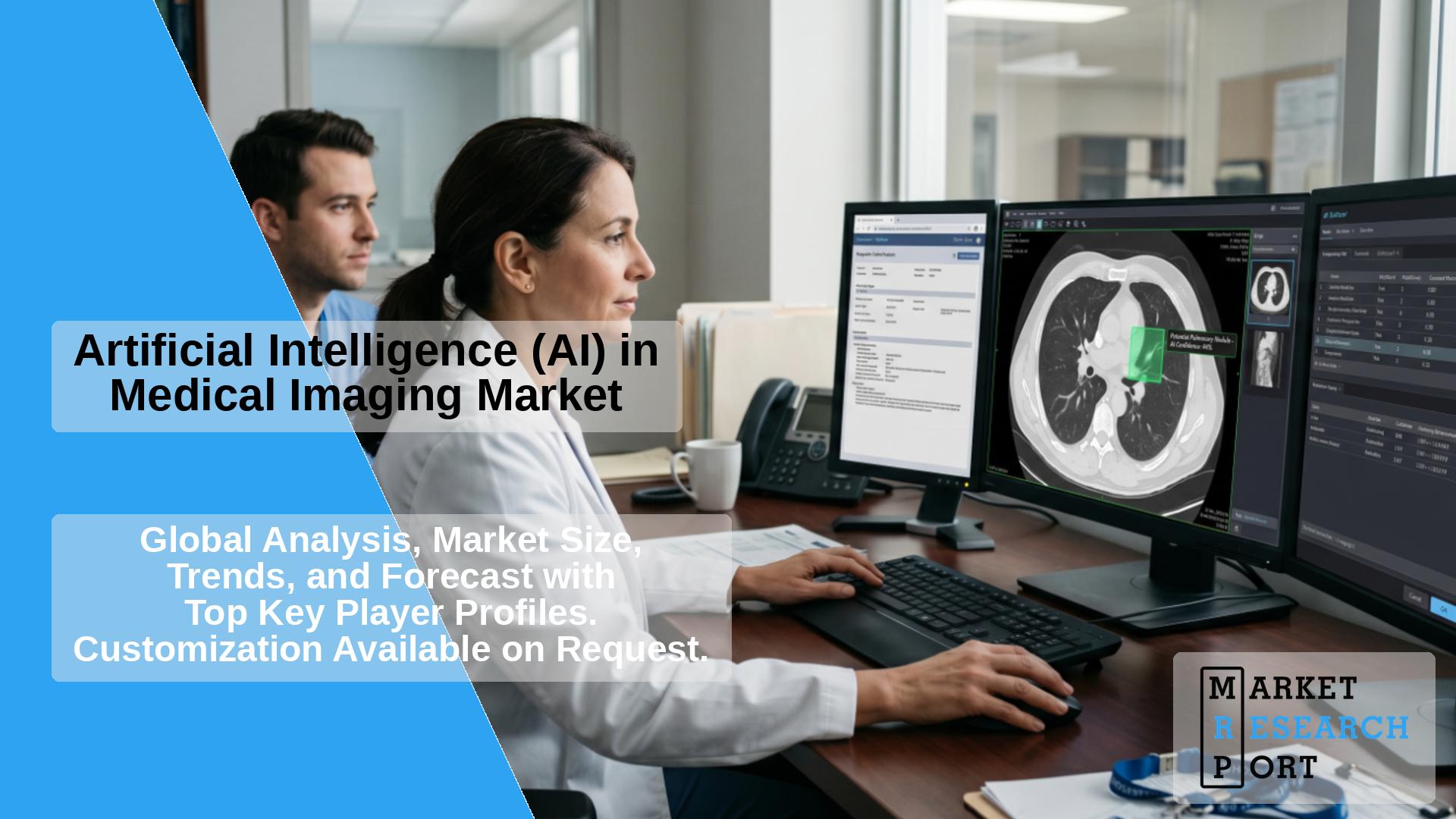
The global artificial intelligence (AI) in medical imaging market size is estimated at USD 5,240.5 million in 2026 and is projected to reach USD 38,512.8 million by 2036, growing at a CAGR of 22.1% from 2026 to 2036. The market’s expansion is primarily driven by the increasing volume of medical imaging data, the rising prevalence of chronic diseases, and the critical need for early and accurate diagnosis. Furthermore, the shortage of radiologists globally and the growing integration of cloud-based AI solutions are significantly contributing to the market’s upward trajectory.
The convergence of healthcare and advanced computing has led to a transformative era in diagnostic medicine. Artificial Intelligence (AI) in medical imaging involves the use of complex algorithms and software to emulate human cognition in the analysis, interpretation, and comprehension of complicated medical data. Specifically, AI tools are designed to assist clinicians in identifying patterns within images such as X-rays, CT scans, and MRIs that might be imperceptible to the human eye. This technological leap is essential for addressing the mounting pressure on healthcare systems, where the demand for imaging services often outpaces the availability of qualified radiologists. By automating routine tasks and providing decision support, AI enhances workflow efficiency and reduces the likelihood of diagnostic errors.
However, the market faces several hurdles that could impede its full potential. Data privacy and security remain paramount concerns, as AI systems require access to vast repositories of sensitive patient information to train and refine their algorithms. The ‘black box’ nature of some deep learning models also poses a challenge, as clinicians and regulatory bodies often require transparency in how an AI reaches a specific diagnostic conclusion. Additionally, the high cost of implementing AI infrastructure and the lack of standardized protocols for interoperability between different imaging systems can deter smaller healthcare facilities from adopting these advanced tools. Regulatory pathways, while evolving, still present a complex landscape for developers seeking to bring new AI-driven diagnostic products to market.
Despite these challenges, the opportunities for growth are substantial. The shift toward value-based care is encouraging hospitals to invest in technologies that improve patient outcomes and reduce long-term costs. The emergence of ‘AI-as-a-Service’ (AIaaS) models is making these tools more accessible to smaller clinics by lowering the initial capital expenditure. Furthermore, the integration of AI with other emerging technologies, such as 5G and edge computing, is expected to enable real-time image analysis even in remote locations. As algorithms become more sophisticated and datasets more diverse, the precision and reliability of AI in medical imaging will continue to improve, solidifying its role as an indispensable component of modern healthcare.
The global AI in medical imaging market is characterized by a high degree of innovation and a moderately consolidated competitive landscape. Large, established medical technology companies are increasingly acquiring or partnering with specialized AI startups to enhance their existing imaging portfolios. This trend has led to a market where a few major players hold significant influence, yet the ecosystem remains vibrant with numerous niche participants focusing on specific applications like oncology or cardiology. The high concentration of R&D investment among top-tier firms allows for the rapid development of sophisticated deep learning models, while smaller firms drive innovation in specialized diagnostic areas.
Market characteristics include a strong emphasis on regulatory compliance and clinical validation. For an AI tool to be commercially viable, it must undergo rigorous testing to meet the standards set by organizations like the FDA in the United States or the EMA in Europe. Another defining feature is the move toward multi-modal AI, which can analyze data from various imaging sources simultaneously to provide a more comprehensive view of a patient’s health. The market is also seeing a transition from simple detection tools to more complex predictive analytics, which can forecast the progression of diseases and suggest personalized treatment plans based on imaging biomarkers.
The CT scan segment led the market and accounted for the largest revenue share in 2026. This dominance is attributed to the widespread use of CT imaging in emergency departments and for the diagnosis of complex conditions such as cancer and cardiovascular diseases. AI algorithms for CT scans are highly advanced, capable of performing tasks such as automated lung nodule detection, calcium scoring in coronary arteries, and stroke assessment. The high volume of CT data generated globally provides a rich training ground for AI models, leading to high diagnostic accuracy and clinical trust in these tools. As healthcare providers seek to manage the high throughput of CT imaging, AI-driven workflow optimization becomes a critical value proposition.
The MRI segment is expected to grow at a significant CAGR from 2026 to 2036. MRI is inherently more complex than other modalities due to the variety of pulse sequences and the high dimensionality of the data. AI is being utilized to reduce MRI scan times—a major pain point for patients and providers—by reconstructing high-quality images from undersampled data. Furthermore, AI in MRI is making significant strides in neuroimaging, where it assists in identifying subtle structural changes associated with Alzheimer’s disease, multiple sclerosis, and brain tumors. The ability of AI to provide quantitative analysis of tissue characteristics is expected to drive its adoption in specialized MRI applications over the next decade.
The deep learning segment accounted for the largest revenue share in 2026 and is expected to maintain its lead throughout the forecast period. Deep learning, a subset of machine learning based on artificial neural networks, is particularly well-suited for image recognition tasks. Convolutional Neural Networks (CNNs) have revolutionized medical imaging by enabling the automated extraction of features from images without the need for manual engineering. This technology has demonstrated the ability to match or even exceed human performance in specific tasks, such as identifying skin cancer from dermatoscopic images or diabetic retinopathy from fundus photographs. The continuous improvement in computing power and the availability of large-scale labeled datasets are the primary drivers for this segment.
The machine learning (ML) segment, while distinct from deep learning in this analysis, also plays a crucial role, particularly in predictive analytics and structured data integration. ML algorithms are used to combine imaging findings with clinical data, such as laboratory results and patient history, to provide a holistic diagnostic picture. This technology is vital for developing risk-stratification models and personalized medicine approaches. While deep learning excels at ‘seeing’ the image, traditional machine learning is often used for the ‘reasoning’ part of the diagnostic process, making it a staple in comprehensive AI platforms.
The oncology segment dominated the market in 2026, driven by the critical role of imaging in cancer screening, staging, and treatment monitoring. AI tools are being extensively used to detect early-stage tumors in breast, lung, and prostate cancers, where early intervention significantly improves survival rates. In radiation oncology, AI assists in the precise contouring of tumors and organs-at-risk, reducing the time required for treatment planning and minimizing damage to healthy tissue. The increasing global burden of cancer and the push for precision oncology are expected to keep this segment at the forefront of the AI medical imaging market.
The cardiology segment is projected to grow at the fastest CAGR during the forecast period. Cardiovascular diseases remain the leading cause of death globally, and AI offers transformative potential in this field. AI applications in cardiology include automated measurement of heart chamber volumes, ejection fraction calculation, and the detection of coronary artery disease from CT or ultrasound images. The rise of point-of-care ultrasound (POCUS) equipped with AI guidance is also expanding the reach of cardiac imaging to non-specialists, further driving market growth. As AI becomes more integrated into routine cardiac workflows, its ability to provide rapid, reproducible measurements will be a key driver for adoption.
The North America AI in medical imaging market held the largest revenue share in 2026. This is due to a combination of factors, including a well-established healthcare system, high healthcare expenditure, and the presence of many leading AI technology providers. The U.S. FDA has been proactive in creating regulatory frameworks for AI-based medical devices, leading to a high number of cleared AI algorithms in the region. Additionally, the strong focus on research and development within academic medical centers and the rapid adoption of cloud computing in healthcare have created a fertile environment for AI integration.
The Europe market is another major contributor, driven by strong government support for digital health initiatives and a robust medical device industry. Countries like Germany, the UK, and France are leading the way in implementing AI in clinical practice. The European Union’s focus on data sovereignty and ethical AI is shaping the development of the market, with a strong emphasis on transparent and explainable AI models. The integration of AI into national health systems, such as the NHS in the UK, is providing a significant boost to the regional market.
The Asia Pacific market is expected to witness the fastest growth from 2026 to 2036. This growth is fueled by the massive population base in China and India, coupled with an increasing investment in healthcare infrastructure. In these regions, AI is seen as a vital tool to bridge the gap between the high demand for diagnostic services and the limited number of trained medical professionals. Local startups in China and Japan are developing innovative AI solutions tailored to regional health challenges, such as the high prevalence of gastric and liver cancers. Government initiatives to promote AI and the rapid digitalization of hospital records are further accelerating market penetration in Asia Pacific.
The market is characterized by a mix of traditional imaging giants and specialized AI software developers. These companies are focusing on developing end-to-end platforms that integrate seamlessly into existing hospital information systems and picture archiving and communication systems (PACS). Strategic collaborations, product launches, and obtaining regulatory clearances are the primary strategies employed by these players to maintain their market position.
The following are the leading companies in the AI in medical imaging market:
This report forecasts revenue growth at global, regional, and country levels and provides an analysis of the latest industry trends in each of the sub-segments from 2026 to 2036.
Modality Outlook (Revenue, USD Million, 2026 – 2036)
Technology Outlook (Revenue, USD Million, 2026 – 2036)
Application Outlook (Revenue, USD Million, 2026 – 2036)
End-user Outlook (Revenue, USD Million, 2026 – 2036)
Region Outlook (Revenue, USD Million, 2026 – 2036)
1. How big is the AI in medical imaging market?
The global AI in medical imaging market size was estimated at USD 5,240.5 million in 2026 and is expected to reach USD 38,512.8 million by 2036.
2. What is the projected growth rate of the market?
The market is expected to grow at a compound annual growth rate (CAGR) of 22.1% from 2026 to 2036.
3. Which region holds the largest market share?
North America dominated the market in 2026, accounting for the largest revenue share due to its advanced healthcare infrastructure and high adoption of digital technologies.
4. What are the primary drivers for this market?
Key drivers include the rising volume of imaging data, the need for diagnostic accuracy, the shortage of radiologists, and the increasing prevalence of chronic diseases like cancer and heart disease.
5. Which modality is leading the market?
The CT scan modality currently leads the market due to its extensive use in emergency and oncology diagnostics and the availability of robust AI algorithms for this modality.
6. What technology is most commonly used in AI medical imaging?
Deep learning is the most dominant technology, as it is highly effective at complex image recognition and feature extraction tasks.
7. What are the main challenges facing the market?
Challenges include data privacy concerns, high implementation costs, the ‘black box’ nature of AI models, and the need for standardized regulatory pathways.
8. Who are the key players in the AI in medical imaging market?
Major players include GE Healthcare, Siemens Healthineers, Philips Healthcare, NVIDIA, Google Health, and specialized startups like Aidoc and Lunit.
9. How does AI improve patient outcomes in medical imaging?
AI improves outcomes by enabling earlier disease detection, reducing diagnostic errors, personalizing treatment plans, and optimizing hospital workflows for faster care delivery.
10. Which application area is expected to grow the fastest?
The cardiology segment is expected to witness the fastest growth due to the high global burden of heart disease and the rapid development of AI tools for cardiac ultrasound and CT.