
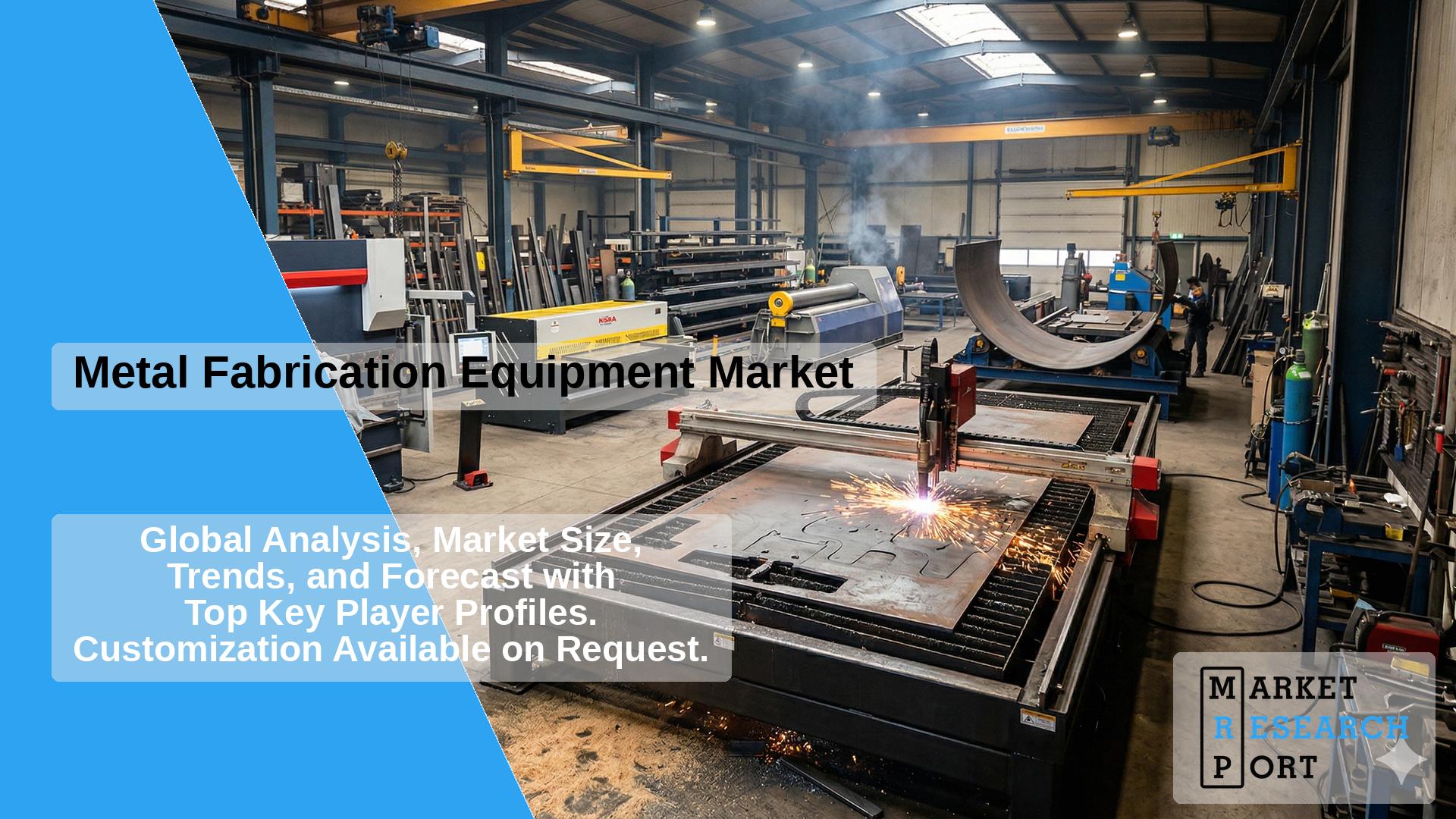
The global metal fabrication equipment market size was estimated at USD 85,450.0 million in 2026 and is projected to reach USD 135,180.0 million by 2036, growing at a CAGR of 4.7% from 2026 to 2036. The market’s expansion is primarily driven by the rapid adoption of automation in manufacturing, the rise of Industry 4.0, and increasing demand from the automotive and aerospace sectors for high-precision components. Technological advancements in fiber laser cutting and robotic welding are further accelerating market growth.
The global landscape for metal fabrication equipment is undergoing a profound transformation as manual processes give way to sophisticated, automated systems. This shift is catalyzed by the need for higher throughput, reduced material waste, and the ability to work with complex alloys. The transition toward green energy and electric mobility has created a surge in demand for lightweight yet durable metal structures, necessitating advanced fabrication tools. Furthermore, the aerospace industry’s recovery and expansion have led to increased requirements for precision machining and specialized welding equipment capable of handling titanium and other high-performance materials. The market is also benefiting from the rise of modular construction, which utilizes prefabricated metal components to speed up building timelines.
Despite the positive outlook, the market faces several hurdles, including high initial capital expenditure and a shortage of skilled operators for advanced CNC and robotic systems. Small and medium-sized enterprises (SMEs) often struggle with the cost of upgrading to the latest fiber laser or multi-axis machining centers. Additionally, fluctuations in raw material prices, such as steel and aluminum, can impact the overall profitability of fabrication shops, indirectly affecting equipment demand. Supply chain disruptions for critical electronic components and semiconductors used in machine controllers also pose a risk to production timelines. However, the long-term trend toward localized manufacturing and the ‘China Plus One’ strategy are encouraging investments in new fabrication facilities across Southeast Asia and North America.
Substantial growth opportunities exist in the development of hybrid manufacturing systems that combine additive and subtractive processes. The integration of software solutions for predictive maintenance and real-time monitoring is becoming a key differentiator for equipment manufacturers. As sustainability becomes a corporate priority, energy-efficient machines that reduce power consumption and carbon footprints are gaining traction. The expansion of the renewable energy sector, particularly wind and solar, requires large-scale metal fabrication for towers, frames, and mounting systems, providing a steady stream of demand for heavy-duty cutting and welding equipment. Furthermore, the democratization of laser technology is making high-precision tools more accessible to a broader range of industrial users.
The global metal fabrication equipment market is characterized by a high degree of consolidation among a few dominant players who possess extensive R&D capabilities and global distribution networks. Major companies such as Amada, TRUMPF, and Bystronic lead the market through continuous innovation and strategic acquisitions. These industry leaders focus on providing end-to-end solutions, including hardware, software, and service support. While the upper tier is consolidated, the market also features numerous specialized regional players that cater to specific niches, such as high-pressure waterjet cutting or specialized bending tools for the medical device industry. This structure allows for both large-scale standardized production and highly customized fabrication solutions.
The market is defined by rapid technological cycles, where equipment becomes obsolete faster due to software updates and improvements in laser source efficiency. The shift from CO2 lasers to fiber lasers is a prime example of how technological shifts can reshape market shares within a decade. Customer loyalty is often tied to software ecosystems and after-sales service, as the downtime of a primary cutting or welding machine can be catastrophic for a fabrication business. Consequently, manufacturers are increasingly focusing on ‘smart’ features that allow for remote diagnostics and automated material handling, reducing the reliance on human intervention and increasing the overall equipment effectiveness (OEE).
The cutting equipment segment led the market in 2026, accounting for a substantial portion of the total revenue. This dominance is attributed to the fundamental role of cutting in almost every fabrication workflow. Within this segment, fiber laser cutting machines have seen explosive growth due to their superior speed, lower maintenance costs, and ability to cut reflective materials like brass and copper more effectively than traditional CO2 lasers. Plasma cutting remains relevant for heavy plate fabrication in the construction and shipbuilding industries, while waterjet cutting is preferred for heat-sensitive materials and thick stones or composites. The continuous improvement in laser power, with 20kW and 30kW machines becoming more common, is pushing the boundaries of what can be achieved in high-speed fabrication.
The welding equipment segment is expected to witness the fastest growth during the forecast period. This is driven by the massive adoption of robotic welding cells in the automotive and heavy machinery sectors. Robotic welding offers unmatched consistency and speed compared to manual welding, addressing the global shortage of certified welders. Innovations in laser welding are also gaining momentum, providing deep penetration and minimal heat-affected zones, which is critical for battery pack manufacturing in the EV sector. Furthermore, the development of collaborative robots (cobots) for welding is allowing smaller shops to automate their processes without the need for extensive safety guarding or complex programming, making automation more accessible than ever before.
Machining centers, including CNC milling and turning machines, represent another vital segment. The demand for 5-axis machining is rising as aerospace and medical components become increasingly complex. These machines allow for the production of intricate geometries in a single setup, improving accuracy and reducing lead times. The integration of live tooling in turning centers is also blurring the lines between milling and turning, enabling multi-tasking capabilities. As industries move toward high-mix, low-volume production, the flexibility of modern machining centers becomes a critical asset for fabricators looking to diversify their service offerings.
The automotive segment accounted for the largest revenue share in 2026. The industry’s transition to electric vehicles is a major catalyst, as EVs require new types of structural components, battery enclosures, and lightweight frames. Metal fabrication equipment is essential for processing high-strength steel and aluminum alloys used to offset the weight of heavy battery packs. The shift toward gigacasting and large-scale integrated components is also changing the types of machining and finishing equipment required by automotive OEMs. Furthermore, the global expansion of charging infrastructure requires significant amounts of fabricated metal for stations and enclosures, providing a secondary growth lever for the market.
The aerospace & defense segment is projected to grow at a significant CAGR through 2036. This growth is fueled by the increasing production rates of commercial aircraft and the modernization of military fleets. Aerospace fabrication demands the highest levels of precision and material integrity, driving the sales of high-end CNC machines and specialized welding systems. The use of exotic materials like Inconel and titanium requires equipment with high torque and advanced cooling systems. Additionally, the burgeoning commercial space industry is creating a new frontier for metal fabrication, with rockets and satellites requiring specialized thin-gauge welding and precision machining of large-scale components.
Construction and infrastructure represent a steady and massive market for metal fabrication equipment. The global push for infrastructure renewal, particularly in North America and Europe, and the ongoing urbanization in Asia and Africa, drive the demand for structural steel fabrication. Heavy-duty plasma cutters, large-format bending machines, and automated beam welding lines are essential for producing the girders, trusses, and frames used in modern buildings and bridges. The rise of green building standards is also encouraging the use of fabricated metal for energy-efficient facades and solar panel mounting systems, integrating the construction sector with the renewable energy transition.
Asia Pacific dominated the global market in 2026, with a revenue share exceeding 40%. China remains the world’s manufacturing hub, possessing a massive ecosystem of fabrication shops and equipment manufacturers. The Chinese government’s focus on high-end manufacturing through initiatives like ‘Made in China 2025’ has spurred investments in advanced CNC and laser equipment. India is also emerging as a powerhouse, driven by the ‘Make in India’ campaign and significant infrastructure projects. The region’s growth is further supported by the presence of major automotive and electronics clusters in Japan, South Korea, and Taiwan, which continuously upgrade their fabrication capabilities to maintain global competitiveness.
The North American market is experiencing a resurgence driven by the reshoring of manufacturing and the need to modernize aging industrial infrastructure. The United States is at the forefront, with significant investments in the semiconductor, EV, and aerospace sectors. Government incentives, such as the CHIPS Act and the Inflation Reduction Act, are encouraging companies to build new domestic production facilities, which in turn drives demand for state-of-the-art metal fabrication tools. There is a strong emphasis on automation and software integration in this region to compensate for higher labor costs. Canadian and Mexican markets are also benefiting from integrated North American supply chains, particularly in the automotive and heavy machinery sectors.
Europe is a hub for high-end, precision metal fabrication equipment, with Germany, Italy, and Switzerland hosting some of the world’s most innovative machine tool builders. The European market is characterized by a strong focus on Industry 4.0, sustainability, and energy efficiency. German manufacturers lead the way in integrating AI and IoT into fabrication workflows, enabling ‘lights-out’ manufacturing. The region’s strict environmental regulations are driving the adoption of fiber lasers and eco-friendly finishing processes. While the market is mature, the replacement cycle for older, less efficient machines provides a steady stream of revenue. The expansion of the offshore wind energy sector in the North Sea is also creating significant demand for large-scale metal fabrication equipment.
Latin America is seeing steady growth, particularly in Brazil and Mexico, driven by the automotive and mining sectors. Mexico’s role as a nearshoring destination for the U.S. market has led to the establishment of advanced fabrication facilities. In the Middle East and Africa, the market is primarily driven by the oil and gas industry and large-scale infrastructure projects. Countries like Saudi Arabia and the UAE are diversifying their economies, leading to the growth of local manufacturing and fabrication sectors. The demand in these regions is often focused on heavy-duty equipment capable of operating in harsh environments, such as large-scale welding systems for pipelines and heavy plate cutting for industrial tanks.
The competitive landscape is dominated by companies that offer a combination of high-performance hardware and sophisticated software ecosystems. Innovation is the primary battleground, with players racing to release higher-power laser sources, faster robotic controllers, and more intuitive user interfaces. Strategic partnerships with software providers and automation specialists are becoming common as companies seek to offer complete ‘smart factory’ solutions. Customer support and service networks are also critical, as the global nature of manufacturing requires localized technical expertise and rapid spare parts delivery.
| Report Attribute | Details |
|---|---|
| Market size value in 2026 | USD 85,450.0 million |
| Revenue forecast in 2036 | USD 135,180.0 million |
| Growth rate | CAGR of 4.7% from 2026 to 2036 |
| Base year for estimation | 2025 |
| Historical data | 2020 – 2024 |
| Forecast period | 2026 – 2036 |
| Quantitative units | Revenue in USD million and CAGR from 2026 to 2036 |
| Report coverage | Revenue forecast, company ranking, competitive landscape, growth factors, and trends |
| Segments covered | Type, Application, Region |
| Regional scope | North America; Europe; Asia Pacific; Latin America; Middle East & Africa |
| Country scope | U.S.; Canada; Mexico; Germany; UK; France; Italy; Spain; China; India; Japan; South Korea; Brazil; Argentina; Saudi Arabia; South Africa |
| Key companies profiled | Amada Co., Ltd.; TRUMPF; Bystronic Laser AG; Mitsubishi Electric; Mazak; Salvagnini; Prima Power; IPG Photonics; ESAB; Lincoln Electric; ITW; Messer Cutting Systems; Flow International; DMG Mori; Haas Automation |
This report forecasts revenue growth at global, regional, and country levels and provides an analysis of the latest industry trends in each of the sub-segments from 2026 to 2036.
Type Outlook (Revenue, USD Million, 2026 – 2036)
Application Outlook (Revenue, USD Million, 2026 – 2036)
Region Outlook (Revenue, USD Million, 2026 – 2036)
1. How big is the metal fabrication equipment market?
The global metal fabrication equipment market was valued at USD 85,450.0 million in 2026 and is expected to grow significantly over the next decade.
2. What is the projected market size by 2036?
The market is projected to reach USD 135,180.0 million by 2036, driven by industrial automation and the growth of the EV sector.
3. What is the expected CAGR for the market?
The market is anticipated to grow at a compound annual growth rate (CAGR) of 4.7% from 2026 to 2036.
4. Which region holds the largest market share?
Asia Pacific dominated the market in 2026, accounting for over 40% of global revenue, primarily due to the manufacturing strength of China and India.
5. Which application segment is the largest?
The automotive segment is the largest application area, as the shift toward electric vehicles requires advanced fabrication for new chassis and battery components.
6. What are the key drivers for the market?
Key drivers include the adoption of Industry 4.0, the rise of fiber laser technology, the need for robotic welding to address labor shortages, and global infrastructure development.
7. Who are the leading players in the market?
Major players include Amada Co., Ltd., TRUMPF, Bystronic Laser AG, Lincoln Electric, and Mitsubishi Electric, among others.
8. Why is fiber laser cutting growing so fast?
Fiber lasers offer higher speeds, lower operating costs, and better precision compared to traditional CO2 lasers, especially for thin to medium-thickness metals.
9. What impact does Industry 4.0 have on this market?
Industry 4.0 enables smart factories where fabrication equipment is interconnected, allowing for real-time data monitoring, predictive maintenance, and highly flexible production cycles.