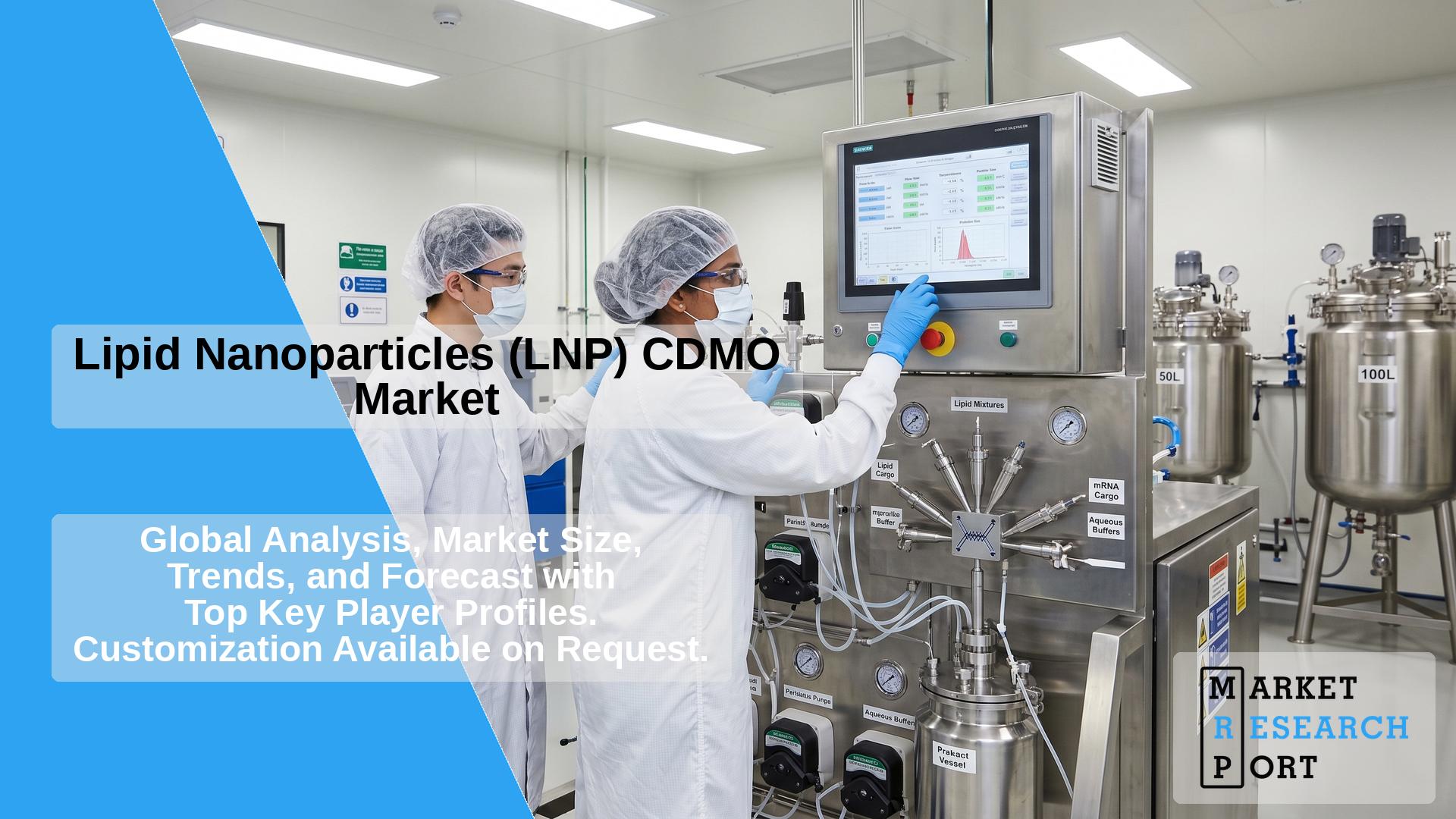
The global lipid nanoparticles (LNP) CDMO market size is estimated at USD 1,845.2 million in 2026 and is projected to reach USD 7,654.8 million by 2036, growing at a CAGR of 15.3% from 2026 to 2036. The market’s expansion is primarily driven by the unprecedented success of mRNA-based therapeutics, the rising prevalence of chronic diseases requiring advanced drug delivery systems, and the increasing outsourcing of complex manufacturing processes by pharmaceutical and biotechnology firms to specialized Contract Development and Manufacturing Organizations (CDMOs).
The rapid evolution of genomic medicine has placed lipid nanoparticles at the forefront of pharmaceutical innovation. As the primary delivery vehicle for mRNA vaccines and gene therapies, LNPs provide the necessary protection for fragile genetic material while ensuring efficient intracellular delivery. The transition from emergency-use vaccine production to long-term therapeutic applications in oncology, rare diseases, and infectious diseases has created a sustained demand for high-quality LNP manufacturing. CDMOs are increasingly investing in specialized infrastructure, such as cleanrooms equipped with advanced mixing technologies and cold-chain logistics, to cater to this burgeoning sector. The shift toward personalized medicine further necessitates agile manufacturing platforms capable of producing small-batch, patient-specific formulations, a niche where specialized CDMOs excel.
However, the industry faces substantial hurdles related to intellectual property (IP) landscapes and technical complexities. The formulation of LNPs involves a precise balance of four key lipids: ionizable lipids, PEGylated lipids, helper lipids, and cholesterol. Navigating the patent thicket surrounding these components often complicates the development process for new entrants. Furthermore, the manufacturing process requires extreme precision; even minor deviations in mixing speeds or temperature can lead to polydispersity issues or reduced encapsulation efficiency. The high capital expenditure required for specialized equipment and the shortage of skilled personnel with expertise in nanomedicine formulation also act as significant barriers to entry, concentrating market power among established players with proven track records.
Despite these challenges, the market is ripe with opportunities, particularly in the development of next-generation LNPs. Innovations focusing on targeted delivery—where LNPs are engineered to release their payload in specific tissues or organs—are gaining traction. This tissue-specific targeting can significantly reduce off-target effects and improve the therapeutic index of RNA drugs. Additionally, the move toward lyophilized or thermostable LNP formulations aims to eliminate the need for ultra-low temperature storage, broadening the global reach of these therapies. As regulatory bodies like the FDA and EMA establish clearer guidelines for nanomedicines, the path to commercialization is becoming more predictable, encouraging further investment in the LNP CDMO space.
The global LNP CDMO market is characterized by a high degree of consolidation among a few tier-one players who possess integrated capabilities ranging from lipid synthesis to fill-finish. Major organizations such as Lonza, Catalent, and Merck KGaA dominate the landscape, leveraging their extensive global footprints and deep regulatory expertise. These leaders often engage in strategic acquisitions to bolster their technological portfolios, such as acquiring niche biotech firms specializing in proprietary lipid libraries or microfluidic platforms. While the market is concentrated at the top, a growing number of mid-sized and specialized CDMOs are emerging, focusing on specific stages of the value chain or localized regional markets, particularly in Europe and Asia.
Innovation is a primary driver of market dynamics. CDMOs are increasingly adopting automated and continuous manufacturing processes to improve consistency and reduce production timelines. The integration of artificial intelligence and machine learning in lipid screening is also accelerating the discovery of novel ionizable lipids with better safety profiles. Furthermore, the market is seeing a trend toward ‘one-stop-shop’ models, where CDMOs provide end-to-end services, including analytical testing, stability studies, and regulatory filing support. This holistic approach helps pharmaceutical companies reduce the complexity of managing multiple vendors and speeds up the time-to-market for critical therapies.
The formulation development segment accounted for a substantial portion of the market revenue in 2025. This segment involves the critical task of designing the lipid shell to optimize encapsulation efficiency and biological activity. Given that different therapeutic areas—such as vaccines versus gene editing—require different LNP characteristics, custom formulation development is essential. CDMOs provide expertise in screening lipid ratios and selecting the appropriate mixing technology to achieve the desired particle size and stability. The rise in diverse RNA modalities, including siRNA, saRNA, and circRNA, is further fueling the demand for specialized formulation services.
Manufacturing services, encompassing both clinical and commercial scales, are expected to grow at a rapid pace. Clinical manufacturing is currently the larger sub-segment by volume, driven by the massive pipeline of mRNA candidates in early-stage trials. However, as these candidates progress toward late-stage trials and eventual approval, the demand for commercial-scale manufacturing is projected to surge. Commercial manufacturing requires rigorous adherence to cGMP standards and the ability to scale up production without compromising product quality. CDMOs that can offer seamless transition from clinical to commercial scales are highly valued by drug developers.
The clinical scale segment led the market in 2025, reflecting the high intensity of R&D activity in the genetic medicine space. Most LNP-based projects are currently in Phase I or Phase II trials, requiring relatively small batches produced under strict regulatory oversight. CDMOs specializing in clinical scale operations offer the flexibility needed for iterative testing and process optimization. This stage is crucial for establishing the ‘Quality by Design’ (QbD) parameters that will eventually govern large-scale production.
The commercial scale segment is anticipated to be the fastest-growing area through 2036. The success of mRNA vaccines has proven the feasibility of large-scale LNP production, and as more RNA-based therapies for common conditions like cardiovascular disease or cancer receive approval, the volume requirements will increase exponentially. Transitioning to commercial scale involves significant engineering challenges, such as maintaining uniform mixing in large-volume reactors and ensuring sterile fill-finish at high speeds. CDMOs with established commercial-scale infrastructure and a history of successful regulatory inspections are positioned to capture this growth.
Biotechnology companies represent the largest end-user segment for LNP CDMO services. Many biotech firms, particularly startups and mid-sized entities, operate on a ‘virtual’ or ‘asset-light’ model, focusing on drug discovery while outsourcing the capital-intensive manufacturing process. For these companies, CDMOs provide access to sophisticated technology and regulatory expertise that would be prohibitively expensive to develop in-house. The influx of venture capital into the RNA space has further empowered these biotech firms to engage in multi-year partnerships with leading CDMOs.
Pharmaceutical companies also contribute significantly to market demand. While some large pharma players have invested in internal LNP capabilities, many still rely on CDMOs for overflow capacity or to access proprietary technologies they do not possess. Outsourcing allows pharmaceutical giants to mitigate the risks associated with building dedicated facilities for products that may still be in the experimental phase. Additionally, academic and research institutes utilize CDMO services for the production of high-quality LNP batches for preclinical studies and pilot trials, ensuring that their research is based on clinically relevant formulations.
North America dominated the global LNP CDMO market in 2025 and is expected to maintain its lead through 2036. This dominance is rooted in the region’s robust biotechnology ecosystem, high levels of R&D investment, and the presence of major industry pioneers. The United States, in particular, serves as a global hub for mRNA research, supported by both private capital and government initiatives like BARDA. The presence of world-class academic institutions and a favorable regulatory environment further bolster the market. CDMOs in North America are often at the cutting edge of technological innovation, offering advanced services like CRISPR-Cas9 delivery formulation.
Europe holds the second-largest market share, driven by strong pharmaceutical sectors in countries like Germany, Switzerland, and the United Kingdom. European CDMOs are known for their high quality standards and deep expertise in lipid chemistry. The region has seen significant investment in ‘Bio-clusters’ that foster collaboration between researchers and manufacturers. Germany, as a leader in the mRNA space, has been a focal point for LNP manufacturing expansion, with several major CDMOs increasing their capacity to meet both domestic and international demand.
The Asia Pacific region is projected to be the fastest-growing market during the forecast period. This growth is fueled by the rapid expansion of the biopharmaceutical sectors in China, India, and South Korea. Governments in these countries are providing significant incentives for the development of domestic vaccine and gene therapy capabilities. Furthermore, the lower cost of operations and the increasing availability of a highly skilled workforce are attracting global pharmaceutical companies to outsource their manufacturing to Asian CDMOs. China’s focus on ‘Biopharma 4.0’ and its massive investments in genomic medicine are positioning it as a formidable competitor in the global LNP landscape.
Latin America and the Middle East & Africa are emerging markets with steady growth potential. In Latin America, Brazil and Argentina are developing their domestic vaccine production capabilities, often through technology transfer agreements with global players. In the Middle East, countries like the UAE and Saudi Arabia are investing heavily in biotechnology as part of their economic diversification strategies. While these regions currently represent a smaller share of the global market, the increasing focus on regional health security and the localized production of essential medicines will drive future demand for LNP CDMO services.
The following are the leading companies in the lipid nanoparticles (LNP) CDMO market. These organizations are at the forefront of manufacturing innovation and strategic partnerships.
Lonza, headquartered in Switzerland, is a global leader in the CDMO space, providing comprehensive services for the development and manufacturing of complex biologics. The company has made significant investments in LNP technology, particularly through its collaboration with Moderna for the production of mRNA vaccines. Lonza’s global network of facilities allows for rapid scaling and localized production, meeting the needs of both global pharmaceutical firms and emerging biotech startups. Their focus on automated platforms and digitalized manufacturing ensures high levels of consistency and regulatory compliance.
Catalent, based in the United States, offers a wide range of drug delivery technologies and manufacturing solutions. The company has significantly expanded its LNP capabilities through strategic acquisitions and facility upgrades. Catalent’s expertise in sterile fill-finish and specialized packaging complements its LNP formulation services, providing a seamless end-to-end solution for clients. Their commitment to innovation is evident in their development of advanced analytical methods for characterizing nanoparticles, which is critical for ensuring the safety and efficacy of RNA-based drugs.
Merck KGaA, through its Life Science business (MilliporeSigma), is a major provider of both the raw materials (lipids) and the manufacturing services required for LNP production. The acquisition of Exelead has further strengthened their position, allowing them to offer integrated services from lipid synthesis to clinical and commercial manufacturing. Merck’s deep understanding of lipid chemistry and their extensive portfolio of proprietary lipids make them a preferred partner for companies developing novel LNP formulations.
| Report Attribute | Details |
| Market size value in 2026 | USD 1,845.2 million |
| Revenue forecast in 2036 | USD 7,654.8 million |
| Growth rate | CAGR of 15.3% from 2026 to 2036 |
| Base year for estimation | 2025 |
| Historical data | 2020 – 2024 |
| Forecast period | 2026 – 2036 |
| Quantitative units | Revenue in USD million and CAGR from 2026 to 2036 |
| Report coverage | Revenue forecast, competitive landscape, growth factors, and trends |
| Segments covered | Service Type, Scale of Operation, End-use, Region |
| Regional scope | North America; Europe; Asia Pacific; Latin America; Middle East & Africa |
| Country scope | U.S.; Canada; Germany; UK; France; China; India; Japan; South Korea; Brazil |
This report forecasts revenue growth at global, regional, and country levels and provides an analysis of the latest industry trends in each of the sub-segments from 2026 to 2036.
Service Type Outlook (Revenue, USD Million, 2026 – 2036)
Scale of Operation Outlook (Revenue, USD Million, 2026 – 2036)
End-use Outlook (Revenue, USD Million, 2026 – 2036)
Region Outlook (Revenue, USD Million, 2026 – 2036)
1. What is the projected size of the Lipid Nanoparticles (LNP) CDMO market by 2036?
The global market is expected to reach approximately USD 7,654.8 million by 2036, driven by the expansion of RNA-based therapeutics beyond vaccines.
2. What is the expected growth rate (CAGR) for this market?
The market is projected to grow at a compound annual growth rate (CAGR) of 15.3% from 2026 to 2036.
3. Which region currently leads the LNP CDMO market?
North America holds the largest market share, supported by a dense concentration of biotech firms and significant R&D investment in genomic medicine.
4. Who are the major players in the LNP CDMO industry?
Key players include Lonza, Catalent, Thermo Fisher Scientific, Merck KGaA, Evonik, and WuXi Biologics, among others.
5. What are the primary factors driving market growth?
The main drivers include the success of mRNA technology, the rising pipeline of gene therapies, and the increasing trend of pharmaceutical companies outsourcing complex manufacturing to specialized CDMOs.
6. What are Lipid Nanoparticles (LNPs)?
LNPs are specialized delivery vehicles composed of lipids that encapsulate and protect genetic material (like mRNA or siRNA) for delivery into target cells.
7. Why do companies outsource LNP manufacturing to CDMOs?
Outsourcing provides access to specialized technical expertise, advanced mixing technologies, and cGMP-compliant facilities without the need for massive internal capital investment.
8. Which segment is expected to grow the fastest by service type?
Commercial manufacturing is expected to see the fastest growth as more RNA-based products move from clinical trials to market approval.
9. What are the technical challenges in LNP manufacturing?
Challenges include maintaining particle size uniformity, ensuring high encapsulation efficiency, navigating complex IP landscapes, and managing cold-chain requirements.